Day 63: People Are Strange

For the 4-Play of my writing today, I watched cheesy videos on the Internet and learned:

59 million people have listened to a lady repeat the phrase “sitting on the toilet” about sixteen times. I played it twice and tried to count, and gave up. It ends with a flush.

19 million watched a “fat kid on rollercoaster” for 57 seconds. Who posts that?

35 million people watched a ninja baby for 36 seconds. That one was sort of cute.

10 million watched “young girl drops c-word on national TV…Twice.” It was on the Today Show.

Now I’m watching something called “Extreme Face Omelet.”

Each day I live, I become more confused by culture.

It’s been about an hour, and I’ve yet to find something I’d actually want to share with you. Except for the fact that my husband thinks I’m stranger than ever.

After watching freaky eaters, strange addictions, soggy flappy faces in slow motion, and Weird Al, and the like, I am quite worried that if alien life forms have access to human’s video clips, they’ll choose to extinguish the entire human race.

I’ve concluded: People are Strange.

At least we’ll always have the Brady Bunch.

My husband wanted me to remind you that the Brady Bunch lost to the dog act when they did their Keep on Movin’ dance scene.

Today, I was planning to share a story about how I was beaten with a board by strangers when I was a little girl. Now, after my introduction, I’m laughing and realizing child abuse just doesn’t fit with the feel of this post. So I’m keeping with the Strange Theme.

Unverified Strange Facts About People

Unverified because I’m not in college anymore, and I do not want to back things up with research ever again! Please keep in mind, my idea of strange is subjective and may not accurately represent your idea of strange.

  1. Some people let snakes slither on their backs for a snake massage. The treatments are said to ease migraines and soothe sore muscles.
  2.  In a sleep study researches discovered dreams prevent psychosis.
  3. Charles Dickens slept facing North. He believed this act would improve his writing.
  4. There are more collect calls on Father’s Day than any other day of the year.
  5. Thomas Edison was afraid of the dark.
  6. In a survey Americans revealed banana was their favorite smell.
  7. Married men change their underwear twice as often as single men.
  8. On average 100 people will choke to death on ballpoint pens each year.
  9. On average a person farts 14 times a day.
  10. The earth could be repopulated to its current population level by the number of sperm that could fit in an aspirin capsule!
  11.  You are actually reading what I write in detail.

*Important side note: The colder the room you sleep in, the better the chances are that you will have a bad dream. That’s why I’ve had so many bad dreams since moving to Washington State.

Famous People With Autism (Unverified but cool!)


For those of you who need more:

Weird Laws Around the World

Top Ten Festivals for People to Throw Things


Day 62: Females with Asperger’s Syndrome (Non-Official) Checklist

I invite you to take a look inside of my book Everyday Aspergers.

Take a look here.

(I just deleted an entire paragraph explaining why I am uncomfortable with self-promotion. I’ll spare you the details!)

Hello All.

I hope you are well during these challenging times.

I am writing to provide a few updates (2020) for anyone who happens upon this page.

My third blog is a bit hard to find, since I changed the domain name. Here is the direct link to Everyday Autistic. My artist’s blog is Belly of a Star.

Here is the Autistic Trait’s List.

Here is my company website Spectrum Suite LLC, which includes 100s of resources and our services page.

Here is a link to one of my Linkedin Articles that will bring you to my profile and some articles there!

My new works include much advocacy for Universal Design in the Workplace, which equates to true inclusivity, where all employees are given opportunity to the same support measures and community engagement, such as the same best-practices interviews, job coaches, support team; not just one marginalized minority, e.g., autistic individuals.

I am working on a book on empowerment on the autism spectrum.

I am my waving from afar, and wishing you so very well! I cannot believe it’s been 8 YEARS!

Feel free to connect on twitter or Facebook.

I’m on the bottom right, in the photo below, speaking at the Stanford Neurodiversity Summit. You can find out what we’ve been up to on the website. Here is a 10 hr.+ video of Day 2 at the Summit!

My book is now available around the world in paperback! Check out Barnes and Noble or Amazon.

Everyday Aspergers is an unusual and powerful exploration of one woman’s marvelously lived life. Reminiscent of the best of Anne Lamott, Everyday Aspergers jumps back and forth in time through a series of interlocking vignettes that give insight and context to her lived experience as an autistic woman. The humor and light touch is disarming, because underneath light observations and quirky moments are buried deep truths about the human experience and about her own work as an autistic woman discerning how to live her best life. From learning how to make eye contact to finding ways to communicate her needs to being a dyslexic cheerleader and a fraught mother of also-autistic son, Samantha Craft gives us a marvelous spectrum of experiences. Highly recommended for everyone to read — especially those who love people who are just a little different.”~ Ned Hayes, bestselling author of The Eagle Tree

https://www.book2look.com/book/KRksrIxTxr

Females with Aspergers Non-Official Checklist

By Samantha Craft of Everyday Asperger’s, March 2012

This is a non-official checklist created by an adult female with Asperger’s Syndrome who has a son with Asperger’s Syndrome. Samantha Craft holds a Masters Degree in Education. Samantha Craft does not hold a doctorate in Psychiatry or Psychology. She has a life-credential as a result of being a female with Asperger’s Syndrome and being a parent of a child with Asperger’s Syndrome. She has created this list in an effort to assist mental health professionals in recognizing Asperger’s Syndrome in females.

Suggested Use: Check off all areas that strongly apply to the person. If each area has 75%-80% of the statements checked, or more, then you may want to consider that the female may have Asperger’s Syndrome.

Section A: Deep Thinkers

1. A deep thinker

2. A prolific writer drawn to poetry

3. Highly intelligent

4. Sees things at multiple levels including thinking processes.

5. Analyzes existence, the meaning of life, and everything continually.

6. Serious and matter-of-fact in nature.

7. Doesn’t take things for granted.

8. Doesn’t simplify.

9. Everything is complex.

10. Often gets lost in own thoughts and “checks out.” (blank stare)

Section B: Innocent

1. Naïve

2. Honest

3. Experiences trouble with lying.

4. Finds it difficult to understand manipulation and disloyalty.

5. Finds it difficult to understand vindictive behavior and retaliation.

6. Easily fooled and conned.

7. Feelings of confusion and being overwhelmed

8. Feelings of being misplaced and/or from another planet

9. Feelings of isolation

10. Abused or taken advantage of as a child but didn’t think to tell anyone.

Section C: Escape and Friendship

1. Survives overwhelming emotions and senses by escaping in thought or action.

2. Escapes regularly through fixations, obsessions, and over-interest in subjects.

3. Escapes routinely through imagination, fantasy, and daydreaming.

4. Escapes through mental processing.

5. Escapes through the rhythm of words.

6. Philosophizes continually.

7. Had imaginary friends in youth.

8. Imitates people on television or in movies.

9. Treated friends as “pawns” in youth, e.g., friends were “students,” “consumers,” “soldiers.”

10. Makes friends with older or younger females.

11. Imitates friends or peers in style, dress, and manner.

12. Obsessively collects and organizes objects.

13. Mastered imitation.

14. Escapes by playing the same music over and over.

15. Escapes through a relationship (imagined or real).

16. Numbers bring ease.

17. Escapes through counting, categorizing, organizing, rearranging.

18. Escapes into other rooms at parties.

19. Cannot relax or rest without many thoughts.

20. Everything has a purpose.

Section D: Comorbid Attributes

1. OCD (Obsessive Compulsive Disorder)

2. Sensory Issues (sight, sound, texture, smells, taste)

3. Generalized Anxiety

4. Sense of pending danger or doom

5. Feelings of polar extremes (depressed/over-joyed; inconsiderate/over-sensitive)

6. Poor muscle tone, double-jointed, and/or lack in coordination

7. Eating disorders, food obsessions, and/or worry about what is eaten.

8. Irritable bowel and/or intestinal issues

9. Chronic fatigue and/or immune challenges

10. Misdiagnosed or diagnosed with other mental illness and/or labeled hypochondriac.

11. Questions place in the world.

12. Often drops small objects

13. Wonders who she is and what is expected of her.

14. Searches for right and wrong.

15. Since puberty, has had bouts of depression.

16. Flicks/rubs fingernails, flaps hands, rubs hands together, tucks hands under or between legs, keeps closed fists, and/or clears throat often.

Section E: Social Interaction

1. Friends have ended friendship suddenly and without person understanding why.

2. Tendency to over-share.

3. Spills intimate details to strangers.

4. Raised hand too much in class or didn’t participate in class.

5. Little impulse control with speaking when younger.

6. Monopolizes conversation at times.

7. Bring subject back to self.

8. Comes across at times as narcissistic and controlling. (Is not narcissistic.)

9. Shares in order to reach out.

10. Sounds eager and over-zealous at times.

11. Holds a lot of thoughts, ideas, and feelings inside.

12. Feels as if she is attempting to communicate “correctly.”

13. Obsesses about the potentiality of a relationship with someone, particularly a love interest.

14. Confused by the rules of accurate eye contact, tone of voice, proximity of body, stance, and posture in conversation.

15. Conversation can be exhausting.

16. Questions the actions and behaviors of self and others, continually.

17. Feels as if missing a conversation “gene” or thought-“filter”

18. Trained self in social interactions through readings and studying of other people.

19. Visualizes and practices how she will act around others.

20. Practices in mind what she will say to another before entering the room.

21. Difficulty filtering out background noise when talking to others.

22. Has a continuous dialogue in mind that tells her what to say and how to act when in a social situations.

23. Sense of humor sometimes seems quirky, odd, or different from others.

24. As a child, it was hard to know when it was her turn to talk.

25. She finds norms of conversation confusing.

Section F: Finds Refuge when Alone

1. Feels extreme relief when she doesn’t have to go anywhere, talk to anyone, answer calls, or leave the house.

2. One visitor at the home may be perceived as a threat.

3. Knowing logically a house visitor is not a threat, doesn’t relieve the anxiety.

4. Feelings of dread about upcoming events and appointments on the calendar.

5. Knowing she has to leave the house causes anxiety from the moment she wakes up.

6. All the steps involved in leaving the house are overwhelming and exhausting to think about.

7. She prepares herself mentally for outings, excursions, meetings, and appointments.

8. Question next steps and movements continually.

9. Telling self the “right” words and/or positive self-talk doesn’t often alleviate anxiety.

10. Knowing she is staying home all day brings great peace of mind.

11. Requires a large amount of down time or alone time.

12. Feels guilty after spending a lot of time on a special interest.

13. Uncomfortable in public locker rooms, bathrooms, and/or dressing rooms.

14. Dislikes being in a crowded mall, crowded gym, or crowded theater.

Section G: Sensitive

1. Sensitive to sounds, textures, temperature, and/or smells when trying to sleep.

2. Adjusts bedclothes, bedding, and/or environment in an attempt to find comfort.

3. Dreams are anxiety-ridden, vivid, complex, and/or precognitive in nature.

4. Highly intuitive to others’ feelings.

5. Takes criticism to heart.

6. Longs to be seen, heard, and understood.

7. Questions if she is a “normal” person.

8. Highly susceptible to outsiders’ viewpoints and opinions.

9. At times adapts her view of life or actions based on others’ opinions or words.

10. Recognizes own limitations in many areas daily.

11. Becomes hurt when others question or doubt her work.

12. Views many things as an extension of self.

13. Fears others opinions, criticism, and judgment.

14. Dislikes words and events that hurt animals and people.

15. Collects or rescues animals. (often in childhood)

16. Huge compassion for suffering.

17. Sensitive to substances. (environmental toxins, foods, alcohol, etc.)

18. Tries to help, offers unsolicited advice, or formalizes plans of action.

19. Questions life purpose and how to be a “better” person.

20. Seeks to understand abilities, skills, and/or gifts.

Section H: Sense of Self

1. Feels trapped between wanting to be herself and wanting to fit in.

2. Imitates others without realizing.

3. Suppresses true wishes.

4. Exhibits codependent behaviors.

5. Adapts self in order to avoid ridicule.

6.  Rejects social norms and/or questions social norms.

7. Feelings of extreme isolation.

8. Feeling good about self takes a lot of effort and work.

9. Switches preferences based on environment and other people.

10. Switches behavior based on environment and other people.

11. Didn’t care about her hygiene, clothes, and appearance before teenage years and/or before someone else pointed these out to her.

12. “Freaks out” but doesn’t know why until later.

13. Young sounding voice

14. Trouble recognizing what she looks like and/or has occurrences of slight prosopagnosia (difficulty recognizing or remembering faces).

Section I: Confusion

1. Had a hard time learning others are not always honest.

2. Feelings seem confusing, illogical, and unpredictable. (self’s and others’)

3.  Confuses appointment times, numbers, or dates.

4. Expects that by acting a certain way certain results can be achieved, but realizes in dealing with emotions, those results don’t always manifest.

5. Spoke frankly and literally in youth.

6. Jokes go over the head.

7. Confused when others ostracize, shun, belittle, trick, and betray.

8. Trouble identifying feelings unless they are extreme.

9. Trouble with emotions of hate and dislike.

10. Feels sorry for someone who has persecuted or hurt her.

11. Personal feelings of anger, outrage, deep love, fear, giddiness, and anticipation seem to be easier to identify than emotions of joy, satisfaction, calmness, and serenity.

12. Situations and conversations sometimes perceived as black or white.

13. The middle spectrum of outcomes, events, and emotions is sometimes overlooked or misunderstood. (All or nothing mentality)

14. A small fight might signal the end of a relationship or collapse of world.

15. A small compliment might boost her into a state of bliss.

Section J: Words and Patterns

1. Likes to know word origins.

2. Confused when there is more than one meaning to a word.

3. High interest in songs and song lyrics.

4. Notices patterns frequently.

5. Remembers things in visual pictures.

6. Remembers exact details about someone’s life.

7. Has a remarkable memory for certain details.

8. Writes or creates to relieve anxiety.

9. Has certain “feelings” or emotions towards words.

10. Words bring a sense of comfort and peace, akin to a friendship.

(Optional) Executive Functioning   This area isn’t always as evident as other areas

1. Simple tasks can cause extreme hardship.

2. Learning to drive a car or rounding the corner in a hallway can be troublesome.

3. New places offer their own set of challenges.

4. Anything that requires a reasonable amount of steps, dexterity, or know-how can rouse a sense of panic.

5. The thought of repairing, fixing, or locating something can cause anxiety.

6. Mundane tasks are avoided.

7. Cleaning may seem insurmountable at times.

8. Many questions come to mind when setting about to do a task.

9. Might leave the house with mismatched socks, shirt buttoned incorrectly, and/or have dyslexia.

10. A trip to the grocery store can be overwhelming.

11. Trouble copying dance steps, aerobic moves, or direction in a sports gym class.

12. Has a hard time finding certain objects in the house, but remembers with exact clarity where other objects are.

This list was compiled after nine years of readings, research, and experience associated with Asperger’s Syndrome. More information can be found at https://aspergersgirls.wordpress.com © Everyday Aspergers, 2012 This non-official checklist can be printed for therapists, counselors, psychiatrists, psychologists, professors, teachers, and relatives, if Samantha Craft’s name and contact information remain on the print out.

Other Useful Links by Sam Craft:

116 Reasons I Know I have Aspergers

Another Important List of Traits 

1o Myths About Females With Aspergers
Thirty-One: Y’all Come Back, Now!


If you missed Day Thirty’s post, it was a doozy (something extraordinary and bazar)! I had to include the definition. My post was extraordinary in that non-boasting way—out of the ordinary for me. Not so much bazar. Did you know Doozy is an Americanism. I am full-on stopping myself from wandering off and researching Americanism, and what words are Americanized; but if you get an itch, I say scratch it!

I always thought doozy came from the word bulldozer, because a bulldozer picks up an extraordinary amount of dirt, and dozer is similar to doozy. I was wrong.

Just last year, I learned that nosey neighbors do not partake in ease-dropping, they eavesdrop. I thought they eased their way into a conversation—that makes so much more sense than standing under the eaves so one can be in close proximity to overhear a conversation. Imagine trying to explain that one word of eavesdrop to a room full of second-language students. I used to teach second-language students. I would fail.  I can’t draw an eave. And don’t get me started on old wives’  tale….seriously? How about my lifelong version: old wise tale. Better, isn’t it?

My mom used to make a celery at her job (salary). I partook in a friendly game of chest (chess), until I was in my early twenties.  My boyfriend at the time found me simply hilarious. Hamburgers were ham-buggers. As in one of my favorite words: bugger-butt—it’s a term of endearment, in my book.

There is actually another human in the world besides me that Googled: when did the word bugger occur.  Oh my, I can’t share the origin here! Probably shouldn’t use it as a term of endearment anymore. No wonder I stopped eating meat. What’s another word for digress? (Laughing.) Digress also means ramble! Who would have known?

Before I so trade-markedly steered off tangent, Day Thirty’s post was the topic. Yesterday afternoon, I was confronted once again with the injustices of the world in regards to the treatment of my son with Aspergers. Pausing.

It’s so hard to write about this, when Crazy Frog is doing the Mexican hat dance in my head.

After the melancholy (but necessity, I might add) of Day Thirty’s post, Crazy Frog is making up in oddity, double-time. He still is trying to figure out where he was when Elephant plunged through. (If you haven’t looked at my lingo, yet. No doubt I’ve lost you. LINGO BUTTON.) There’s an awesome music video on the lingo page

See what I mean: I wrote this line for this post: “My heart was aflame in grief.”

My heart was. It really was. But not now! ‘Cause Crazy Frog is laughing at my words.

This is what Crazy Frog thinks is ridiculous: 

Melancholic Little Me Wrote in reflection of Day Thirty’s post: “As I wrote those words yesterday, a voice rose and spun up from the depths of me like a steel bristle brush. As it moved upwards, the brush swirled round and scraped off all this goop and gunk that had collected and stuck like barnacles to the symbolic-flesh of my very soul. The words excavated, don’t do the experience justice. I don’t know where this new part of me had been hiding, but I reckon she’s a part that was pushed down right about the time I was four years of age. She’s a feisty thing, all done up, like a strong and mighty male elephant, with a silky-sweet interior. She’s the one hiding behind the curtain. “

Here’s where Crazy Frog stepped in to avoid me going into deep emotional, opposite-of-bliss state. Notice how my voice and inflection change: “Anyhow, this voice, she was mighty powerful, and as I think about her I get an odd Southern dialect mixed in with some back-woods cowboy. Crap? Is backwoods cowboy offensive? Oh! It is. In-bred rednecks. Interesting. It’s actually racist; and I didn’t even know. Is it okay to use the words still, since my relatives have the last name McCoy and lived on a farm near the woods with over twelve children? No offense intended to any in-breeds out there. Or to my family. I guess?? I’m getting flashbacks of when I used the term…(omitted) Oops! I reckon I best be stopping myself right there.

Life is hard, when I can’t even get through a paragraph without worrying about burning someone’s britches. Oh, that doesn’t make sense. I used burning britches the wrong way. I give up. I did find a neat article about eavesdropping and its origin, but I can’t include the link, because the poop-head (LV’s two cents; LINGO BUTTON) that wrote the article included some inappropriate jokes at the end. Seems to me that author has a bit of digression issues herself.”

I think that brief description  illustrates nicely the difference between Little Me (melancholic) and Crazy Frog.

And my point? I spent all day thinking about yesterday’s post—the meaning, the release, the seriousness—until I realized a part of me had resurfaced, one I hadn’t connected with in a very long time. So I’m adding Elephant to my lingo list, and letting Crazy Frog teach Elephant how to dance. (Remember he appears as a him but is a girl inside the elephant suit.) Wow! Real life is stranger than fiction.

I think I’ll take Little Old Me and join Crazy Frog and Elephant now, in that dancing. (Tipping my hat.) And  just let the dust settle from yesterday’s post. See what’s left behind in the dirt, after this backwoods cowgirl rides out into the sunset. Buenos noches. Y’all come back, now! You here.

Thirty: I am Elephant!

Days like today I want to find the highest mountain and shout in my loudest voice, “I am Elephant!”

I want to charge forward with my tusks at a massive pile of hay. Stab and stab with all my might, until no barrier is left, only scattered remnants that the animals can feed upon, digest, and carry away.

I hate, if I ever were to hate anything, the aspect of being misunderstood. I hate that my son is being misunderstood. I hate that I am misunderstood.  I feel as if we, as an Asperger’s “species,” have been set up for failure. As if we are supposed to make ourselves less genuine and honest, in order not to threaten others’ norms.

I understand we represent the unknown that exists outside the comfort box of many individuals. And when we surface, stand there face-to-face in conversation, the anomaly, if you will, is seen as a threat, an oddity, a discomfort; and we are made into this perceived entity that requires some degree of change or adaptation on our part.

I question what is it about the way I think and function that requires fixing and change. What if the way I think and function is ideal? Why is it that the majority believe their way is the right way, when all about them the world is falling apart from war, famine, lies, manipulation, blackmail, disease, hatred, bigotry, and poison? These named leaders play these games using their tricks. Wherein I, coming from a place of honesty and genuineness, am perceived as a threat.

Is the feeling of threat erupting from others’ insecurity or perhaps from the uncomfortable feelings that arise when one’s foundation of what is believed to be the right way is confronted?

Perhaps the way communication is currently played out is from a very limited and self-centered scope. Wherein there is this unspoken dance where I am expected to filter what I say, how I say it, when I say it, and how much I say, as to not risk causing discomfort to someone else.

Assuming I am reasonably self-aware, which I am, and I have no intention of ill will or harm, which holds true, and that I have generally mastered the basic social norms of avoiding insult or rudeness, then what other rules must I add?

It seems to me the other rules include this basket of techniques, sayings, buffering, limitations, and balancing that enable the recipient to feel better about him or herself, or at least not any worse. It seems to me a game where the first priority is to not make waves, to win the person over, to sound strong, and to sprinkle evidence of high intellect and likability, in order to allow the other person to feel comfortable enough to maybe begin to trust me.

Why is it that if I accurately and purposely reflect what the other person wishes to hear and see, that they embrace me and wrap the tentacles of interest around me; but other times, when I am entirely authentic, and I share without pretense, plan, or caution, I am questioned, perhaps even distrusted, judged, singled-out, ridiculed, or admonished? Why is it some human beings want to converse with clones of themselves and make me into their egocentric mirror, instead of knowing me?

Communicating is like driving down a dangerous road where there are warning signs at every turn. Beware!  Make sure your words are continually reinforcing the other person’s identity, perception, and worthiness. Avoid offending, weakening, or threatening a person’s idea of truth. Know that complete honesty triggers alarm in people. Understand that ultimately most people you approach already don’t trust you and you have to build and build trust before they will. Even then, know there will be people who will never trust you.

Why is it when I speak my truth some question my intention, my motive, my want, my need, my desire, my expected outcome, my reasoning, my life, my identity, my self-worth, my perception, my judgment, and/or my personhood? Are these seeds I need to plant seeds of dishonesty?

What if I am not the anomaly? What if my son is not the anomaly? What if the teenagers persecuting him with their bullying and snide remarks are the anomaly? What if my son is the teacher? What if Aspergers isn’t a syndrome or a disorder? What if Aspergers is a new mirror: a mirror that reflects back truth and honesty, and genuineness of spirit?

If communication is to based on a scale dependent on levels of trust, then a person sitting across from me in conversation is continually establishing how much they know me and trust me in order to decide what to share about him or herself, or his or her perception, facts, or experience. How do I decide which parts of me to hide?

Why isn’t communication the opposite of distrust? Why don’t people strip themselves of protective layers and speak their truth? Aren’t we all in search of love and attention? Companionship and sharing? Why don’t we all wear T-shirts that read: Love Me, Please. Isn’t that what we crave? Why is it so hard for someone to walk up to a stranger and say, “You look sad and lonely. I’m sad and lonely, too.”? Why is it people say so easily, “It’s a beautiful day” instead of “You’re a beautiful being”?

Strangers ask me, “Why are you being so nice? How did you become so kind?” or say “No one ever asked me that. Thank you so much for taking an interest?” And yet I am the one who knows not how to communicate naturally?

If withholding information is the norm, then I question the integrity of the establishment who dictates such norms. If one is to say to me, “Impossible; if we all spoke are truth the world would fall apart,” then I ask: “Is the world not already falling apart?”

The majorities’ opinion of what counts as the correct mode of communication style appears backwards and disproportionate. This fear-based approach contradicts the doctrines of many spiritual and religious foundations of unconditional love. I don’t understand this barometer I am supposed to carry into conversation—this inner dialogue, gut-feeling, or what have you, that informs me of what to withhold.

I understand to avoid crudeness, rudeness, defensiveness, argumentation, blame and downright meanness—as I see those derivatives of communication equally fear-based as the self-regulating barometer that predisposes the mind to beware of each and every encounter with another human being.

I do not understand the harm in sharing my authentic self and true feelings, if intention to harm and do ill will are abstracted, and what remains is the representation of the true being. Isn’t this what human race is striving for—the disrobing of falsehoods? Don’t people long for genuineness? If so, then why do I feel so oppressed? Why since my youth have my peers and authority continually been trying to snuff my light? Why do I feel as if I am to be locked in some prism of isolation, left alone with my thoughts, so the world outside doesn’t have to fear my reflection?

I am not bold, I am not brave. I am me! But so many people can’t see me.

I crave purity and truth. I abide by these elemental necessities. Yet, I am continually punished for not partaking in a ritual game, of following some unspoken norms of what is supposed to be. When everywhere I look around me the world is falling apart because of all the unspoken lies, manipulation, greed, and trickery.

This dictated “right” way to communicate, the fear-based approach where people say what is expected, and what the other person probably wants to hear, in order to get at some unspoken goal, appears manipulative, preplanned, and superficial.

Why in society is there a limit to what we are supposed to reveal? I understand donning clothing to conceal the taboo of the naked flesh. I can abide by this norm by simply cloaking my body. But to understand the taboo of sharing the naked spirit—I can find no such cloak. I do not know what to cover my truth in so that a person will listen without their ears first burning or their anger first churning. I do not know how to persuade someone to my side. I see no need, have no want of these things. And for this, again, I am lacking.

I watch as those that conform pass untouched in the night. While I remain oppressed because of my nonconformity. Why must I become an untouchable in order to walk freely? Why must I stay hidden in order to be accepted? As many times as I’ve been crushed and hurt, debased and stabbed in the back for sharing myself, I cannot learn another way to walk in this world. It as if the legs that carry me can walk no other way than the way in which my spirit intends. I am made to be silent or to remain in constant affliction. I am imprisoned by my own desire to be.

This is such a lonely and unspeakable place of pain and shame. And all about me professionals with man-invented degrees are claiming their “truths” of what I am, when they do not even know how to even see who I am. They are aliens dissecting me with their eyes, though they wear spectacles with blackened and tarnished glass. They can see nothing but their own imaginings and what has been told to them by others; others whom had things told to them; whom in turn had things told to them by others, with the origin residing in some theorist, who himself was likely twisted in his views and perception by his need to conform.

In my view, I am an elephant. Being an elephant, I know myself as an elephant. I know how an elephant eats, sleeps, dreams, and walks. And I know other elephants who walk in the same way. Who think in the same way. Yet, I have hyenas all about me telling me what an elephant is like. How an elephant should look and be. Who listens to a hyena to know what the elephant is, when an elephant is standing right beside?

Something must change. That is why I shout, “I am Elephant!”

Twenty-Seven: Who Let the Frog Out?

Don’t be fooled, this post is NOT about dogs or frogs or hamsters!

I tell you it never fails. I sit down to type, and everything I’d planned to say the night before, goes out the window. And mentioning the word window reminds me of the song How Much is that Doggy in the Window. Sir Brain is following that string again—completely off subject. Here’s a funny dog video, then I promise to get back to my post!


Okay folks. Looking to get rich? After viewing a dozen Doggy in the Window YouTube videos, I conjecture you can make a million by producing a quality Doggy in the Window quick flick.  Who is with me?

Oh, one more…. You have to blast this one! It will cheer you up! 


Last night I was up until one in the morning, again!

I was typing a letter, in that therapeutic fashion, with no intention of giving the letter to the recipients. I was planning on sharing the letter with you. Until I woke up this morning and decided the process of writing was healing enough.

And then I thought (that nasty th word again) to share another letter I wrote—which took about four hours—the letter that I will probably be sending to the dean of the university. It outlines in a professional and factual tone the demeaning words one of my professors said to me after class. I was very much an innocent in the situation, and I offer this fact with sincerity and clarity.  Even would swear on something, which is a ritual I don’t quite understand.

Nonetheless, sometimes there is a discrepancy in my mind, let’s say 99% of the time, and I can see the error of my ways, and how I most definitely contributed to an outcome. On the flipside, I can also recognize when I contribute something for the benefit of someone else. In this situation, with the professor, I was a victim. (Picturing a Salem witch trial and people without health insurance.)

I decided, in the end, not to present either letter, because I began to understand my motives. Something I try to be in touch with quite often: the whys of my words and actions. Which, in and of itself, the continual inner questioning, makes for a circus of self-criticism. Perhaps I shall develop a way to question without the critique. And let you know in the next millennium or so, how that pans out.

In questioning my motives to present the letters, I realized I wanted your empathy. I wanted your comments about how you felt so sorry for me, how outraged you were, how terribly sad and teary-eyed you were after reading my words.

And I thought, is that the vibe I truly desire to put out there: come hither; gather round my fire of sorrow and pity me. Support me. Lift me. Concur. Share in my sufferings. I’m shaking my head and squinting my eyes and mouthing, “No.”

Of course there are times when ranting and venting are therapeutic, and I don’t judge those who need to put the frustration all out there. I would say in the majority of cases, venting on a blog is probably a lot healthier than many alternatives—like having a heart attack or throwing a pan at your husband.

I’ll get through this event fine, just as I always do. I understand, to some extent, that my journey is a continual series of lessons. You know those sitcoms that reach 100 episodes and get duplicated in mass production on to dvd’s. Shows like Friends and Seinfeld; those shows you can always find broadcasting somewhere. In a way, my life lessons are somewhat syndicated, in the sense that my life lessons seem to be the same episodes over and over.

I joke that I’m one of those rascal spirits that stood in front of a board of wise spiritual advisors, before my birth, and presented a grand life plan. I was full of pride and accomplishment.

Upon review of my plan, the advisors all laughed hysterically in unison, proclaiming, “No way. Not approved. Too much learning.”

And me, I stood there, all brave like, with little wobbly knees, (as I image myself quite petite in the other realm), and responded, “Oh. Don’t worry. I can handle it!”

And they raised their brow and shook their heads, before waving me on with a sarcastic tone: “Good luck with that.”

Only, I didn’t understand sarcasm.

Then I figure, the door shut and they all had a good laugh.

The jokes on me! Ha! Ha! Ha! (Please insert a bratty-tone to my laugher.)

When situations get rough, as they often somehow seem to do—The Darn Plan is to blame. Often I stare up (or across, or somewhere) to the powers that be (that I purposely choose not to quantify, to avoid unnecessary defense and questioning from my readers), and say, “You were right. I made a mistake! I take it all back. Change the plan. I can’t take the heat!”

But no one answers. Except sometimes my spastic-colon dog, who thinks I screamed treat!

I think my super radical plan came with a contract, and that I signed off all rights for alterations after I took human form. Does anyone know of a life contract lawyer?

The good news is I’m about 200 times stronger than I was forty years ago. Because I figure I’ve been challenged by significant circumstances at least four to five times a year and that I gain one point for each challenge I overcome, which puts me somewhere between the vicinity of 160 and 200 growth points. (Multiplied 40 years by 4 or 5.) Just call me spitfire! ? Did you know that spitfire means: Highly emotional. Someone that is wild and free, without a care in the world. Considered strong and emotionally spiritually. Someone’s whose angry words are like fiery ice. A high-spirited out spoken female. Usually loud, lusty, lovely and pretty and untouchable. Typically a red head. ?

Okay, then, so I’m not a spitfire, but my alter ego is! And that weenie, who stood up to the board of advisors and thought this life was a manageable plan, was certainly, if not a spitfire, out of her mind.  (Which I’m thinking now is very accurate, because if she didn’t have a body—she would be out of her mind! I love the way I think. I really do. I’m a laugh a minute. There’s never a dull moment with LV (little voice in my head), Sir Brain (squishy ball), and Prophet in my Pocket.

I’m thinking….lol

…I’m planning on starting a dictionary for my blog, for inexperienced new readers, so I don’t need to keep explaining LV, Sir Brain, and Prophet in my Pocket. And, since I’m assuming, more characters in this fictional-like story of my life, will continue to surface, I ought to start the dictionary now, rather than later.

I want to include the word hamping.

Hamping is what I’m calling the loops that go on in my mind. Where I have a repetitive thought that I can’t dispel. You understand, I think…just imagine those times you’re on the couch and all you can hear is the chocolate calling you from across the room. “Just one more piece. Just one. What harm can it do? I deserve a little pleasure in my life. Gosh darn it, I’m getting myself a piece of chocolate.” And then you sit back down, after devouring half the bar, and all you can think about is the other half you placed up high on the top shelf so you couldn’t reach it without a lot of effort. And you’re wondering where you put the stepladder.

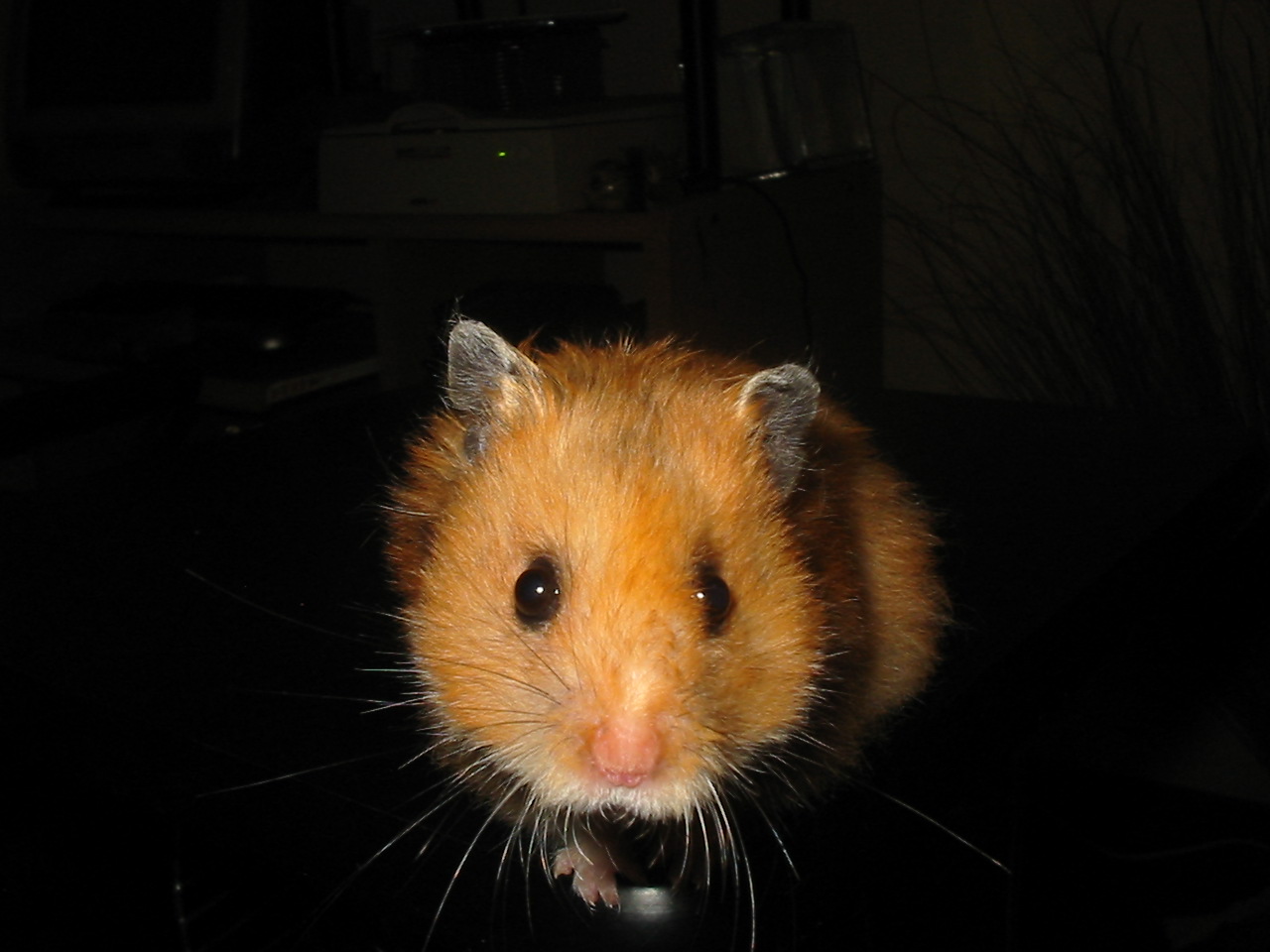
That’s hamping. I call it hamping, because I imagine a cute fuzzy hamster.  If I’m going to have repetitive thoughts, I might as well be adorable while partaking in the process. The hamster is in a cage on a wheel spinning round and round. He can’t help his little old self. Can’t get off, even though he knows he’s going nowhere and that the cat thinks he looks really stupid (and delicious).

Tomorrow I’d like to be able to post all these other stories I’ve been savoring. I have a whole list (in my head), such as my ghost encounter; the premonition of my childhood dog dying; the terrors of college. Wow! Now that I’m listing them all out, I’m thinking I savor the doom and gloom. Melancholic at it’s best!

Well folks, I’m off to go work on the Everyday Aspergers Dictionary now. Or hunt for chocolate. Probably chocolate. LV, Sir Brain, and Prophet are still dancing to Who Let the Frog Out!  As I listened to the song ten times while editing.  Oh! I just found a new character:  Crazy Frog—he’s the one that keeps me laughing.

* You can YouTube “Crazy Frog” for more upbeat music.