Blue is the color for April’s Autism Awareness Month. Proud moms are coloring their hair blue. Kids’ pictures on Facebook are tinted blue. People are donning blue ribbons and displaying blue symbols. I thought this short story, entitled Blue, was fitting for the cause.
I wrote this piece several years ago, as part of a manuscript. I have since broken the manuscript into several short stories. Some of which I share on this blog.
Learning to write took a lot of hard work and practice. In the beginning, I wrote every single day (but one day in April) for a year. I was still a terrible writer then, in my opinion, entirely obsessed with my works, and reading my prose to anyone who would listen.
After the first year of writing, I spent another year editing. Then another year rewriting. Then another rewriting, yet again. I calculate that I spent fifteen hours on each page of the two hundred fifty pages. My biggest hinderance to writing was my dyslexia and difficulty seeing errors. Also, I had a tendency to mix up words and punctuation, and a habit of rambling. (Smiling.)
I hope you enjoy this story.
Blue
Everything inside was blue—the seats, the ceiling, the floor, even the steering wheel. I tugged on a string from the backseat cover, wrapping layer upon layer of blue taught around my finger. This mid-afternoon it was my tiny index finger which turned a slight shade of indigo.
“Nothing to get hung about,” Mother sang out smiling happily, as if the coming rain had already washed away her worries. She didn’t have a singing voice, never had, but the effort and soul were there, the wanting to sound good, and the need. Inside the rearview mirror, her eyes the color of amaretto, glimmered, reflecting the narrowing sunlight. From the backseat I hummed along to Strawberry FieldsForever and jingled my clear-red plastic piggybank in the air, lifting him high and turning his gaze outside.
High atop the rolling grassy hills the enormous oaks stood like rows of fresh cut broccoli, rich and green—the bold color before the broccoli is boiled to a dull olive. In the shadows of the day tall eucalyptus trees were sprinkled between the weathered fruit stands; their silvery leaves rustling, fluttering up and back, yielding to the autumn wind. I winked one eye, then the next and then winked several times again to form patterns of gray, brown and green. A gust of moist wind pushed in through the partially-opened side window, tossing Mother’s chestnut hair and bringing a sharp scent of diesel smoke and wet asphalt… (full story available in the book Everyday Aspergers)
For those of you wondering: Yes, I do have a life outside of processing what’s going on inside my head. It’s just that, at the moment, what’s going on inside my head is extremely fascinating. Just so you know, I did just return from my city’s quaint downtown, with a cheese puff and apple fritter in hand, from the best bakery this side of the western states. And, I might add, I had a hot brewed cup of coffee with just a tad of nutmeg. This, after partaking in a relaxing venue atop the acupuncturist’s cushioned table. The coffee is about to kick in, so I will try to make this fast, as to not dial into manic-mode. I’m one of those types that given a drop of coffee, becomes frantically intense and even more interesting, in that peculiar, glad-I’m-not her, kind of way. I’ve been known to rearrange an entire room, sometimes clean for eight hours straight, given the adequate amount of particular slow-roasted beverage. Coffee is certainly and enigma of our time. I wonder what substance or activity will eventually replace the black gold as our source of rapture and excuse for social gatherings.
I cried all the way home from the bakery, while balancing my coffee, and listening to Jars of Clay. I’ve listened to the same song some 100 times in the last couple of weeks. Finally thought it was time to share the song. I added the video at the end of this post. Though I have reservations, as the group is Christian. Reservations only because I fret you might not listen for that reason alone. Which is sad. Because I’d like you to hear the song, for no other reason but to connect to my experience and feel supported, by whatever support that brings you peace. (For my thoughts on spirituality/religion press HERE.) Because when I listen to the song I picture us all together in a large non-denominational, unconditional-love stadium, think the 1970’s, with our arms up swaying back and forth to the music, and supporting one another through this experience someone once named life.
Sometimes I picture us holding white candles, until I think of the fumes, the potential fire hazard, and the possibility of wax dripping all over my arm. In my vision, we are weeping, in the same way I wept all the way home this morning while wailing aloud to the song—there has to be a word for that huge release of energy that comes from a good cry, the type of cry that explodes with love and knowing that we are not alone. The type of cry that means: I made it to the other side, and I’m still standing! And here we are standing together.
Anyhow, that’s how I was crying. There has to be a word. Maybe: vociferating restitution (wailing with gain-based recovery) combined with hue and cry, (loud public outcry). Restferating Hue! That works. I had a huge restferating hue!
Part of the restferating hue was in response to a video clip I watched yesterday. The other part was the freedom I felt in no longer being connected to the heavy energy from the university. And, yet another, very important piece, is being able to connect with people like you. Well, not like you, but YOU.
Today I would like to plan a gargantuan of a party to celebrate the freedom I am feeling. I think of hosting a party quite often, for you all, in my town in Washington, in the best weather-month ever—August. I’ve said before that I love to plan a party. Not to be at the party, per say, but plan the party.
I imagine the whole of the gathering would be quite the happening. Everything would have to be very well thought out, though. I’m thinking sunglasses and hats, lounge chairs with pillows, soft lightening, definitely name tags, and for certain the use of inside-voices. NO perfumes. NO loud clothing or squeaky shoes. No toenails showing, hair just so, as to not be visually distracting. Sorry, no children—they are far too unpredictable (in a good way).
All attendees need be double-showered, maybe wearing name tags on their backside as well. And background checks would be beneficial. Crazy frog is laughing! (Press LINGO BUTTON, if you’re new to my rambling.)
I do imagine meeting you. Our conventions would be a hoot. I don’t think I can do the entire dialogue, LV’s got going on in her head, justice, as I’d have to wean out a lot of material that LV is giggling about. But let’s just say there is a lot of sensory-issues and people-watching, and tons of brutal honesty.
“How was your flight?”
“Crappy!”
“What’s your greatest fear?”
“Standing here talking to you!”
“If you could be doing anything right now. What would you be doing?”
“Running the other direction.”
Like I said, LV is having a laughing fit!
The BBC video that LV was all happy and get-up-and-go about, introduced the most precious little girl who spoke about personification. Personification: giving human traits (qualities, feelings, action, or characteristics) to non-living objects (things, colors, qualities, or ideas). For example: The rain-covered window is crying. The verb, crying, is a human action. A window is a non-living object.
This discovery is getting a bit too emotional. Just a minute.
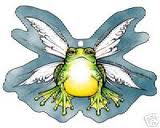
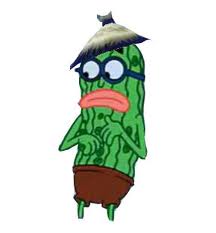
I’m back. Crazy Frog is doing deep breathing exercises, and looks so darn adorable with his green bubble chest inflating so. He’s quite muscular. Let’s all take a deep breath and relax the shoulders, shall we? Better.
I have this thing (there’s no better word I can think of) I do, that I’ve always done, that the little girl in the video does, in a similar fashion.
For the longest time, before knowing other people do this thing, too, I thought I was over-sensitive, connected to another dimension, and/or just plain wacky. Well, even with the discovery, those thoughts haven’t changed.
I’m sure there is some cool British word for wacky. I shall allow Crazy Frog (Lingo) to cut loose from the deep emotional stuff for just a minute.
Crazy Frog is such a Jeeves. (Jeeves = resourceful helper; cool word, right?) He loves Yahoo! Here are some British words for wacky, according to Yahoo! Yes, I know, real alive Brits would be the best direct source, but no Britons happen to be in my house at the moment.
Other words for wacky, British style:
loony
gone off my rocker
nutjob
headbanger
stark raving mad
bonkers
a few sandwiches short of a picnic (cucumber sandwiches?)
completely mental
mad as a hatter
barmy
dippy
total spaz
and my favorite: away with the fairies.
With fairies, I’m thinking a lush green, mossy forest with magical waterfalls and pixie dust sweeping through the air—the smell of honeysuckles and hyacinth flowers.
Wouldn’t you know that hyacinth is my favorite smell, but I can’t pronounce the name. I sound like this when I say the flower name aloud: HIj-sint-HY-sin-t- Hy-nt-sin-ahhhh-ahhhhh. Poop!
I know this wacky list was from Yahoo! So I’m not so certain the list is entirely accurate, but assuming most of the words are, Crazy Frog is thinking, “You Brits have a lot of words for a crazy person.”
Crazy Frog is now trying on different hats, and considering changing his name from Crazy Frog to Sir Barmy. Crazy Frog loves the eccentric, daft, flighty elements of the word. The Daft-Hatter Frog is blowing kisses to himself in the mirror and tipping his hat.
Back up. Scratch that, like there’s no tomorrow. (Sorry if no tomorrow makes you think of the Mayan calendar.)
He just saw that barmy can mean dumbass. He is throwing off tall black hat, and placing daft-hat on nearest politician. I’m liking Crazy Frog.
I’m placing the barmy hat on one of my recent professors whose actions were dumbass in manner. Oops. That kind of slipped out from nowhere. Blame it on the Frog who’s away with the fairies.
So, as I was saying, I do this thing where I personify objects. The little girl in the video clip personified her shoes. She gives objects feelings. If one shoe is on her foot then she feels the other shoe is lonely. And I do the same thing. With shoes, and practically every inanimate object in my world!
For example, this may get a little gross, but if two globs of minty-green toothpaste are clinging on for dear life in my bathroom sink, and one glob is washed down, and the other glob is still there, I feel sorry for the lonely glob! And sorry for the other glob that I washed down the grimy drain, too. Fearing what awaits him. Notice the him. Nothing is an it. There is no it! Which has me thinking, if you haven’t read the children’s classic: A Wrinkle in Time, you ought to. And The Giver, while I’m going there. Strings, strings, strings. Isn’t it cool, if you’re a regular reader of my ramblings, that you actually get my use of strings?
I even sometimes feel sorry for fruits and vegetables, like when I’m shoving cucumber peelings down the garbage disposal to their impending doom. When I used to fry (massacre) potatoes in a cast iron pan, when I was about the age of ten, the potatoes would make a squealing noise, like they were crying in agonizing, your killing us, pain. It was actually just the horrible sound of oil sizzling, but I felt for those particular potatoes. Sometimes I removed the ones that cried the loudest. But then I didn’t know what to do with them. Because who wants to be put in the garbage?
All this personifying is a big part of the reason eating and cooking, even preparing school lunches, is sometimes hard for me. It’s probably why I don’t ever care to empty a jar completely, or don’t finish the last pages of a book. Who wants to be brought to an end?
Personification is likely why I don’t eat meat; although, oddly enough, I have never felt sorry for chocolate. Except, of course, for the left over chocolate that must join the rest of his commune in my stomach, as soon as possible.
This marvelous discovery, this whole personification thing, explains why the other day, I was actually wondering how the strings of celery must be feeling as they were traveling through my digestive track. Sounds loony, right? I pictured the strings like they were at some waterslide park that ended in a tomb of bubbling stomach acid. Who does that?
Well! Supposedly sometimes some other people with Aspergers do that! So there! LV is sticking out her tongue, which is covered in blue from the jaw-breaker she is sucking on. (I even personify my thought processes!)
It’s okay in my heart that I feel sorry for crumpled paper that didn’t get tossed into the bin, and is now stranded on the floor, because there are other earthlings that feel sorry for the paper too.
What huge compassion I have. If you understand the compassion I have for inanimate objects and food, then image the immense compassion I carry for animals and people! It’s phenomenal.
My blog is personified, too. Bet you didn’t know that. It’s a living breathing entity. And when you are there reading my words you validate its life form. That’s why comments and stats are so important to me. If I know someone’s been here the blog is alive. Writing in a journal isn’t the same. The journal remains lonely and untouched. Get it?
Wow! I’m making huge revelations and connections. Now, the only issue is I have to turn off the study light and leave my poor computer idling in sleep mode, alone in the dark. Maybe you can keep him, Mr. Computer, company while I go frolic with the fairies. And why you are at it, when you make a comment, know you’re keeping Mr. Blog from isolation. Cheerio! (That’s goodbye not a cereal.)
Clarification: I didn’t use personification in the exact way one is supposed to use the word. Personification references a rhetorical technique, one of many types of figure of speech or metaphor; whereas pathetic fallacy describes a disposition of the mind. ‘Pathetic’ isn’t derogatory; the word pathetic is in reference to being empathetic towards something. To further research look into pathetic fallacy.
Addition: My Blogging British Friend AilienHippy (BBF) added some more wacky words for me: “Barmy, Bonkers, Plonker, Noodle, Wally, Narna and Nutjob.” She does say, “…away with the fairies. And…He’s off his trolley.” Laughing Housewife added her thoughts, too “…nutter, a bottle short of a six pack.” Schmidleysscribbling (hard one to spell with dyslexia, but a great lady) added: Bodman
Below is the video: Shelter by Jars of Clay. I picture us never walking alone. Upholding one another, and letting our inner light shine! I told you Little Me is a hope-filled melancholic. She can’t help herself.
Often my philosophical prose presents itself to me as a stream of consciousness. The words usually come as I am drifting to sleep or just about to awake. This particular philosophical prose The Wounded Healer appeared as I was resting on the acupuncture table. The message was shown as a page, resembling a scroll. I read the words (in my mind) and heard them simultaneously (with my inner voice). It feels something akin to being a vessel that is downloading information. This gives me the sense that there is much information in energy itself. I like to tease my husband and say, “I am either a genius or getting help from somewhere.” I tend to believe the latter.
I propose that many of us our wounded healers.
I offer this out as an example of philosophical prose. Take or leave what you want from this. It is my sole intention to shed light on my journey. Blessings ~ Sam
“There are many types of healers. They are all brave. No healer is better or lesser than the other. One healer is called The Wounded Healer. Sometimes this may be preferred to as The Wounded Warrior, as they are like warriors, in their undying effort to overcome obstacles and serve. Before coming to this earth Wounded Healers make a soul-contract to answer the calling of a healer. Those that answer the call follow a similar pattern in life; some eventually become healers of great magnitude through various means, others partially complete the process; and still some, as hard as they try to answer the call on this plane, cannot. Still the soul-commitment of a Wounded Healer alone adds to the positive vibration of the earth and heals. And in this way there is always success. A Wounded Healer need do nothing on this planet and still contribute to the healing effect. However, The Wounded Healer that does go on to complete his task will have a huge impact on others’ pain.
Human pain is perceived as physical, emotional, spiritual, mental, and psychological in combination. No pain experienced is singular. Because no pain is singular, Wounded Healers “learn” to understand various levels of pain in their own life. To a great degree, each person on earth has the potential to be a healer. In fact each person in recognizing the light in another human being automatically heals. Thoughts heal. Words heal. But The Wounded Healer varies from many others in that their life’s purpose from birth is to heal. Because of this, there will be distinct markers of a Wounded Healer.
At all times it is beneficial to remember that a Wounded Healer is no greater or lesser than anyone on this plane of existence, and seeing oneself as a Wounded Healer is not meant to elevate or lift a person. In truth a Wounded Healer will feel a great degree of conflict in reading this; not wanting to feel prideful, pleased, or increased in any measure, there will be discomfort in the physical body upon reading these words. For The Wounded Healer’s main objective, above all, is to remain humble in spirit. Without humility, the healing efforts are lessened, not decreased entirely, but depleted with feelings of judgment of self and others. One cannot judge oneself lesser or greater than another, without losing humility. One cannot heal to the greatest degree without humility. Thus, these variants are dependent upon one another; that is to say, give up self to become humble, become humble to heal. Of course, as humans, there is a degree of self-giving and self-worth that is necessary to survive. Therefore, a balance is necessary—that is to say, for The Wounded Healer there needs to be a balance of healing of others and self-love. Though most Wounded Healers, when reaching the fruit of their calling, will be naturally loved and healed through healing others in humility. And therefore, in its greatest capacity, the healing is contradictory in terms of existing as both self-serving and endowed with humility. This is a complicated matter in considering, but no less necessary to explain.
There are five distinct traits of a Wounded Healer. These traits can be used to identify a healer in yourself or others.
(1) Wounded Healers are set on a path of empathy from birth. This is referred to as the “pain-cycle.” Often over-sensitive and naïve in nature, The Wounded Healer will experience pain in all forms before reaching their final role as a Healer of Mankind. This pain will happen throughout many years of their youth, and likely into young adulthood. Some will experience strong degrees of pain for half or more of their life. When this pain-cycle is complete, differs for each healer. When they have experienced the pain intended to experience, the cycle will make a dramatic shift. This will be an obvious shift. Observers will recognize this shift, as will the individual. The shifting of the pain-cycle will feel like a rebirth. This is often predicated by a dramatic change in lifestyle or life choice. This is not to be confused of “hitting bottom” or breaking the cycle of addiction. This is the end result of years of trials and tribulations—one after the other of soul-experience of pain and human-experience of pain, until at last there is a sunrise of a new day. This will literally feel like a “dawning.” There will be no doubt that the pain-cycle has come to an end. Healers will thus still experience pain, pain does not disappear, but the cycle of learning through pain will have ceased to spin.
(2) Often, almost all of the time, the child will experience great trauma in childhood. This will be perceived at one pain-level at minimum, most commonly the psychological-level, but very often the pain comes in combination. Wounded healers choose to experience a childhood of trauma in order to obtain a higher degree of empathy. This trauma (during this current time period) can be seen in all forms of abuse, ridicule, shame, addiction, neglect, malnourishment, poverty and abandonment. In the absence of an outside force produced by others, or in combination, the pain may be self-inflicted, as in perceived ailments of the mind or body. This may take the form of disfigurement, or the inability to be considered by others as “normal.” In later life this pain-cycle may manifest itself in the form of repeated unexplained sickness. These traumas will make a mark on the child. Each mark will serve as a greater good in the years that follow. Each mark indicates a pain that will be released from another being other than the healer. This can be visualized as slashes on the skin. A Wounded Healer carries these slashes that have turned to scars. Each person they heal at a later date will cause a healer’s scar to heal. Thus it follows the more scars a child experiences, the mores pains she is destined to remove from others. But remember, the number of scars is not equated to the number of people. In the process of healing only one person, all of the healer’s scars can vanish. In this way, a Wounded Healer’s soul-purpose may be to heal only one. Whether one or millions are healed is of no difference. Healing one has as much power and magnitude as healing millions. There is no lesser or greater; this is of up most importance to remember. Therefore, a Wounded Healer may complete his contract by healing one or healing many.
(3) All Wounded Healers are called to serve since childhood. It is not uncommon for the child to know before the age of ten what they aspire to be. Whether this vocation transforms rapidly or slowly is dependent upon the pain-cycle the person is to experience. Some will arrive at the vocation at a young age, while other will change jobs many times before answering the call. Still others will slowly transition. All life experience will benefit the Healer’s vocation. In childhood, The Wounded Healer will seek out ways to help others. Oversensitive, they will feel drawn to saving, nursing, rescuing, and easing discomfort. They will notice the wonders of nature that others often overlook. They will cry if a creature is hurt. They will cry if a person is hurt. At one point, in an attempt to survive, they will learn to stop crying as much, and this can cause much inner turmoil. These children will seem wise beyond their years. They will have the strong need to serve the greater good. They will often feel like failures and not good enough. This will be mistaken for low self- esteem. This is not so. These souls have a strong, if not all encompassing need to serve and heal, and when they cannot do so they feel suffocated, inadequate, weak, and not good enough. They might be mistaken by others as depressed, failures, dreamers, or perfectionists. Emotions may be out of control.
4) All wounded healers are empathic and also considered Empathic Healers. The Empathic Healers carry empathic traits, but do not necessarily carry all the traits of a Wounded Healer. The Wounded Healer includes the qualities of an Empathic Healer. However, an Empathic Healer may or may not have the traits of the Wounded Healer, such as: traumatic childhood and pain-cycle. In distinguishing the two, there is no urgency or necessity. But for clarity we point out the difference. Traits of an Empathic Healer include the ability to read the emotional energy field outside of a person. This can or cannot be seen. Usually the energy is felt more than seen. But seeing can be developed with focused practice and attention. Empathics have the ability to pick up on others’ emotional state. They may feel “depleted” in energy around other people, especially in crowds. This is a falsehood to consider the experience a “depletion.” This interpretation implies that there is not enough energy left in the person, and that something has been removed, taken, leaked, or escaped. There is no depletion of energy that is possible. What is happening is the person is taking the others’ energy and reworking the energy so to say, and then returning the energy cleansed to the others. This is like a doctor removing a sample of blood, cleaning the blood, and returning the blood. Only the Empathic Healer is the doctor, the tube holding the blood, and the source of healing. Thus the Empathic Healer is left feeling tired from the process. There is no danger in this except the feeling of exhaustion and the possible susceptibility to taking on another’s pain instead of cleansing the pain. Each Empathic Healer will have to learn how to protect themselves from exhaustion and the transfer of pain. The key is to recognize ultimately there is no pain, and thus, what is really happening is an energy transfer, a giving of one to heal another at a soul-level. This “healing” is complicated, but it is suffice to say the one must recognize the other for the earth to heal, although, even this is very much not the true and ultimate meaning.
5) All wounded healers are repeatedly humbled. This begins in childhood and does not stop for the course of a lifetime. For in order to heal to the greatest degree, as mentioned before, the person must practice and live in humility. Each will do so in various degrees. The greatest healers and shifters of mankind will be the most humble. We need not look far to see who these souls were that existed to transform this world. Not all souls who are Wounded Healers will retreat to the greatest of humility, there will be varying degrees based on culture and the necessity to affect change. How others perceive the healer is still important. Societal rules and regulations, and the status of a person, can all affect the perceived skill of the healer. Therefore, each Healer will have different degrees of humility. Not all seekers will feel comfortable with a half naked man with no teeth. Therefore, Healers are colored in all patterns, and dressed in robes that will attract those needed to fulfill their highest good. This may mean no robe, a tattered robe, a designer robe, or a robe of gold; what matters is not the robe the healer wears but what he houses beneath. A Wounded Healer will heal. This is a matter of practicality. There is no way she cannot.
Wounded since childhood, and sometimes before entering this plane, the soul of The Wounded Healer will seek out help from an early age. They will attempt to remove the pain in many methods. Many of the methods will lead to further humility. Sources such as strict religion, addictive relationships, drugs, alcohol, gambling, overwork, and the like will often accompany the Wounded Healer in his journey through the pain-cycle. Many will seek help through doctors, psychics, energy-healers, therapists, clergy, and counselors, and in this way continue to be humbled. Others may succumb to mental collapse or physical breakdown. Again, they will be stripped to the bare bone. Some will experience great pain through loss and affliction repeatedly, which end results leads to humility. The pain-cycle will continue. When the fruitful time has arrived, The Wounded Healer will break free from the pain-cycle. This is different for each person. If one were to know when the pain would end, this would be no different then knowing the age of death. On knowing the age of death all life is unavoidably lived and experienced differently. Therefore The Wounded Healer has made an agreement to not know when the pain-cycle will end, in order not to affect change or the end result.
Even as the pain-cycle ends, pain remains to a degree. Humility remains, as does the ability to see in others what is in thy own self. Humility then becomes a coat of armor and a friend. A blessed companion we thank the heavens for creating. For in this grand humility we find the comfort of knowing what has come before has served to heal.
In evaluating a Wounded Healer it is best not to use logic but instead to rely on instinct and feeling. A healer of such magnitude, who carries the armor of humility and the pain of many scars, will be notable to you on many levels. First, and foremost, they will carry with them a peace and inner light so that you will have a tendency to feel that you “know” the person or want to know them. You will be attracted to The Wounded Healer and not necessarily know why. This of course is after the completion of the pain-cycle—before this you might actually be propelled away or want to escape. But we speak of the end of the pain-cycle, when the cloak of humility, grace and service is evident. In this time seek you signs of a welcomed presence. This Healer will seem wise beyond his years, will gravitate towards serving others for the sake of healing alone, and will often be serious-minded and unable to easily let go and relax. Overall, in considering The Wounded Healer it is important to remember their coat of humility. For whatever they may say or do, or seem to say or do through your perception, their ultimate goal is healing.” ~ Sam
(No editing was applied to this prose. This all came out in one quick sitting.)
 http://www.youtube.com/watch?v=VILWkqlQLWk


 Everyday Asperger's