470: Past Twelve: Aspergers

image_1351969307655010

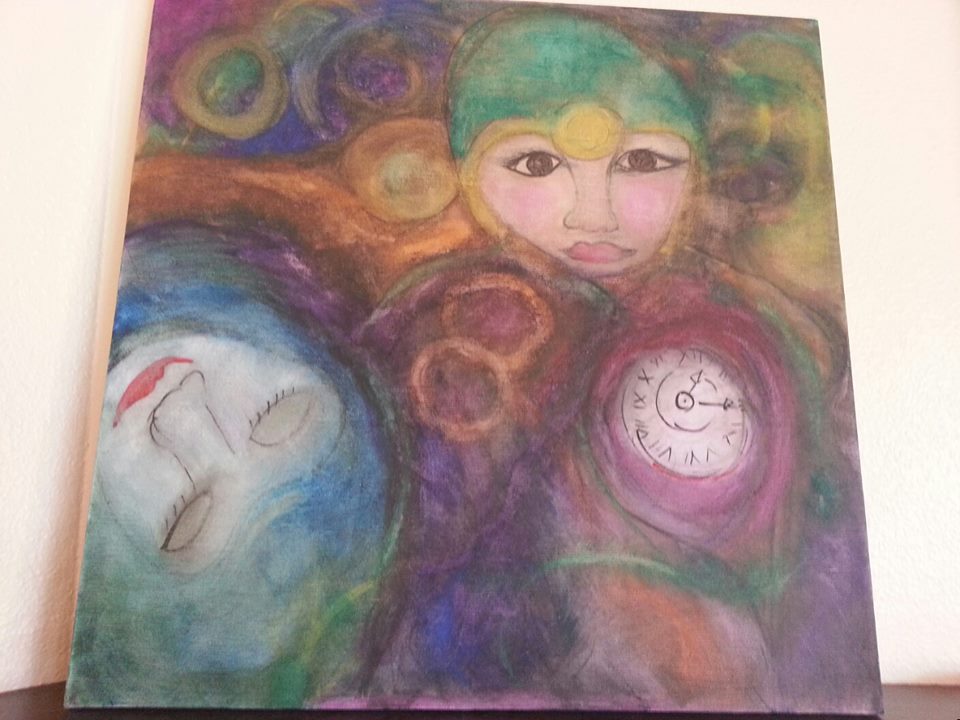
I have to say that twelve was rather easy. I was still very much a child, almost fairy-like, or elven, always into innocent mischief and adventure.

The turmoil hit at the age of thirteen. That is when my hormones shifted and life suddenly became bleak, overwhelming and unmanageable. I discovered a new form of escapism then, a more ‘difficult’ escapism than before; I became more observant of myself and actions, understanding complexities in a new degree that felt unfamiliar and frightening. Before, I would leap into my imagination quite naturally and without pretense. Now, it seemed as if I escaped to get away from some pending danger.

Wherein my world once felt light and airy, full of possibility, and all things magical and hopeful, it now felt dark, dingy and doom-filled.

I didn’t have an active social life for most of my teen years, choosing instead one girlfriend to hang out with and one boyfriend to adore. I had the same best friend from seventh grade until I graduated high school. I never thought to have many friends. I hung out with her, copied her, adopted her taste in music and clothes. I think because I was pretty (but didn’t know it), I easily found boyfriends. I tended to stick with one boy as long as I could or until circumstances forced a breakup. I too, copied what I thought he liked. I tried to appease. But with young men, I found myself continually lost and alone with a separation between us I could not understand or explain. While having a significant other brought me this sense of being less fearful in public and the ability to go out and do more, the relationship also brought me this deep seeded feeling of being complicated, misunderstood, too emotional, and never kind enough.

I could write a full book on the challenges of my teenage years. Here I have attempted to summarize some of the key points:

1. Suffering with feelings of extreme isolation and oddness, but not being able to understand or articulate why I felt this way.

2. Wanting to be like my peers but not wanting to be like my peers. Recognizing their character traits disturbed me, particularly manipulation, game-playing, deceit, cliques (groups of children that didn’t allow other children into the group), lying, cruelty, pretending and gossip.

3. Not knowing why, for most of my childhood, despite circumstances, I had felt happy and content, and that now all of a sudden I felt a deep sadness and a disconnection from the rest of the world.

4. Developing an over-analytical sense of self that encompassed all areas, including how I looked, how I moved, how I spoke and even how I thought and reasoned.

5. Developing a hyper-critical awareness of my appearance, wherein before I could care less. It was an extreme shift from being comfortable in my skin to wanting to change who I was. Along with this intensity of dislike towards my own image, I also did not recognize my own face in the mirror. I had no idea the size of my eyes, my face, my nose, or lips. Nothing seemed distinguishable, and every time I looked in the mirror the image seemed unfamiliar. I consciously did not realize this was happening. I did not understand why I looked at my image so much and analyzed it. I thought I was vain and self-centered, even as I hated how I appeared and assumed no one liked my looks.

6. It did not matter how many times someone told me I was beautiful on the outside, I couldn’t see it, and didn’t believe it. I twisted compliments in my mind. I took a sincere compliment about my appearance and truly believed that the observer was lying, blind, misinformed, tricking me or not educated.

7. I did not trust life. I began to see the unpredictable nature of adults and teenagers. No one around me changed, but suddenly an invisible barrier was lifted and I saw reality more clearly. I had seemed to be coated before, protected in some shield in which the world appeared wonderful and filled with love. I had trusted everyone and believed in everyone; yet now, I believed the world was a scary place, and thought that I had been born on the wrong planet.

8. I didn’t understand my own emotional intensity. I loved deeply. I longed. I was passionate. I was a poet. I was this exploding young woman filled with romantic intentions and the want to get married and have children. I didn’t have any interest in being a teenager. Some part of me wanted to skip from young childhood straight into adulthood. I saw young men as a means of escaping the destitute of reality. I jumped into a fantasy land of tomorrow, when I would be raising a family, and far beyond high school and all its pains.

9. I still trusted everyone. I trusted strangers. I trusted anyone who was an adult. I trusted children. I trusted my peers. I shared from the heart. I told my deepest secrets. I cried openly. And people did not respond in a manner that was beneficial to me. I was preyed upon in all ways: physically, emotionally, spiritually and logically. People could sense I was innocent, naive, and inexperienced. I was very much a victim without knowing I was a victim. I couldn’t tell right from wrong. Because I assumed everyone was good at heart, I assumed everything anyone did was ‘normal’ and ‘okay.’ I didn’t understand that concept of boundaries or self-protection. No one taught me. I didn’t know boundaries existed. I believed people.

10. Concepts that came naturally to other girls did not come naturally to me. I did not understand or follow fashion. I didn’t think to. It never crossed my mind to try to fit in and assimilate to the teenage world. I was still very much twelve inside, even as my body changed. I didn’t start dressing like my peers and learning how to apply makeup until I was ostracized, ridiculed, and singled-out.

11. I didn’t understand sexuality. I had a cute figure and was well-endowed. I did not understand how different ways I walked, sat, or bent over could be perceived as flirtatious and even labeled ‘slutty.’ I didn’t know that I had turned physically into a young woman who men found attractive. Even as they called out names at me, or shouted inappropriate comments about my body in the halls of high school, I didn’t connect the dots. I didn’t know what I had done. And in not knowing what I had done, I didn’t know how to make changes in an attempt to stop others’ behaviors.

12. I copied television and movie stars. I acted like my favorite stars. My role models were a brunette from Gilligan’s Island and a brunette from Charlie’s Angels. And I moved and acted like them, or some other dark-haired daytime soap opera actress. I didn’t know I did this, but I did it nonetheless. I needed a role model, and I found mine on television. Mimicking the traits of sensual and sexual adult females did not add to my ability to fit in; my actions instead served to highlight my inadequacies and oddities. I did things halfway, some very awkward child trying to catch up to her peers and changing body, and not knowing how to even begin, and not recognizing that her subconscious chosen methods were damaging her chances of fitting in further.

13. I didn’t understand my bodily changes and the monthly menstrual cycle. The change had been explained to me in various classes at school, briefly by a parent, and in review of some books, but that information was not enough. I think, in retrospect, I had needed someone to walk me through the process daily for the first year. To explain and reexplain, to reassure me I wasn’t dying or sick, to comfort me when the new and unfamiliar body pains and sensations came, to give me more advanced biological descriptions of what was happening to me. I didn’t do well with change. Change scared me. And here, my entire body was not my body anymore. It was terrifying. I didn’t understand the entire concepts of sex, of the ways I might get pregnant or how to tell if what my peers said was truth or lies. I didn’t understand how things worked.

14. I didn’t understand the concept of holding back. I said things like I saw them and felt them; that is until I was so shamed in school, I clamped up and hid in the corner writing song lyrics in pencil all over my desktop. I didn’t understand social rules and social games. I came across as overzealous, as immature, as goofy, giddy, and somewhat of a ditz. I didn’t understand most jokes. I laughed a lot, out of embarrassment or discomfort. I developed a nervous giggle. I seemed fake to other people, when ironically I was truly myself. People questioned me, especially my facial expressions and body language, and worse they criticized me. If I walked with my head down, with my eyes glued to the floor, my peers claimed I was rude and stuck up, too good for them. If I smiled, I was a flirt. If I avoided eye contact, I was showing disrespect or further showing I thought I was hot stuff and ‘all that.’ I didn’t know how to be. I wasn’t given the tools or the freedom. Everything I did was judged or deemed wrong. I quickly began to surmise the world was a terrible place in which no one was allowed to be herself. And then I concluded I didn’t even know who my self was.

15. I cried a lot. I isolated myself a lot. All the traits of Aspergers were triggered as puberty hit. I was overwhelmed with entirely too much for any child. Not only was my home life unpredictable and chaotic, not only was my body changing, my peers suddenly my enemies, but my own mind was turning against me. I couldn’t tell who I was, what I wanted, and had no idea where to go for help. When I tried to tell adults I was afraid to live, they claimed I was seeking attention, that I was fine, or that I was creating drama. When I went crying to the school counselor, he told me plainly that I was a beautiful attractive and intelligent young lady. And questioned what I could possibly have to complain about. I was attacked on all fronts. No one believed me when I said I felt different and alone. No one believed the deep pain and shattering of my life I was undergoing. I became suicidal, never able to go through with any attempts, but always wondering how it would feel to escape this life. I became more and more of a recluse and found small ways to make my life more manageable. I ate the same lunch every day. I kept the same routine. I knew what path to walk in the halls at school. I knew how to hide. I learned how to pretend to be someone else in mannerisms, dress and behavior. I became that which was nothing but a ghost of me, and I lived that way for most of my days.

_______________

Everyday Aspergers the book available in 2016. Join our Facebook Clan or follow the blog for newest information on book release, including contests and give aways. 🙂 ~ Sam

poetry from my teenage years

image_1353700586831934

425: What if I don’t have Aspergers?

What if I DON’T have Aspergers

But what if I don’t have Aspergers? What if this is just me clinging onto a thread in hopes of not being alone in this world?
What if we are just aliens, light-workers, empaths, sensitives or advanced spiritual beings?
What if I am a reincarnated sage?
What if I am a Buddhist paying for previous karmic waves?
What if I am truly crazy, self-inventing my own condition to feel more normal in claiming I am unique?
What if Aspergers doesn’t exist and this is just a human condition?
What if this whole Aspergers is a trend and being over diagnosed?
What if I am making this up in my head to fit in with a collective?
What if I find out from an expert I have something else and not Aspergers?
Am I smart enough to have Aspergers?
Am I odd enough?
Am I enough of anything?
Pleaseeeeeeeeeeeeeeeeeeeeeeeeeeeee stop!
Who cares?
Really?
Get rid of the name. Call it a chicken-foot fungus dance. Call it the mushroom’s puke master. Call it genius. Call it gifted. Call it looney. I don’t really care!
WE found each other. And WE have more in common than not after years of feeling isolated and alone.

I don’t care what man-invented name, based on a collective documented list of traits based on the observation of some male behavior years ago, was the reason we met. WE met. And that’s what Aspergers means to me: Union.

We are together. We are no longer alone.
Perhaps we ARE from another planet.
Perhaps we are the only humans really here and the rest are reptilians.
Perhaps we are light-workers.
Perhaps we are entirely lost and confused.
Perhaps we are crazy nuts.
Perhaps we are the change the world needs.
Perhaps we are a trend, a wake, or a breaking.
Perhaps we are the new normal.
Perhaps we are just like everyone else.
I don’t care.
Stop trying to analyze what we are and who we are and why we are, and accept WE ARE.
There is no you verses them. There is no us verses them. There is no separation.
It is all just manmade games.
We just managed to survive.
To keep our heads above water.
To see through the madness.
To understand there are things, definite things that need changing in this world.
And if we want to start focusing on self-awareness, self-love, and self-acceptance, then YAY US.
I don’t care how you get there
.to that point where life starts to make sense and you start to realize you aren’t alone and aren’t imperfect and have so much to give the world.
I just want you to know YOU matter and YOU make a difference and YOU are never alone.
Stop tromping over our parade, all of you doubters, critics, and people who feel the need to give your two cents about something that isn’t your journey.
I don’t care.
I really don’t.
Beyond the need I feel to tell the rest, who have struggled in pain so very long, that you are right where you need to be. Whatever you need to hold onto to build yourself up after this world has attempted to break you down, is what you need and is YOUR choice.
Shine, shine, shine.
It doesn’t matter if you have Aspergers or don’t, or if this word never exists again.
Let go of the word and reasons.
Just let go.
Breathe.
And be.
I love you.
Whatever you choose to call yourself.

416: How I would free my spectrum daughter

Charcoal finalCharcoal final
Sophia

How I would free my daughter with Aspergers

1. I would learn everything I could about the spectrum conditions through reputable, well-honored sources; and then readily forget everything I knew and recognize my daughter is a unique individual with exact perfection and a glorious light.

2. I would acknowledge each and every way my daughter’s actions reflect a behavior that in some way makes me believe that I am affected. What is it that she is doing that is causing discomfort to me, would be a question I would demolish, and whole-heartedly embrace the conclusion that I am the only one choosing to be in a state of discomfort based on someone else’s reactions and actions. And in truth my reactions have a direct effect on everyone about me. My ‘job’ as a parent, if I were to assign an exact ‘role’ and ‘duty,’ would be to reflect back to my daughter her beauty and nothing more.

3. I would concentrate on the definitions of imperfection, flawed, wrong, and normal. I’d understand all words are manmade and invented, that even the deepest of spiritual beliefs and psychology have been spoon-fed from man to man, and thusly infected and created into something man-based. With man comes fear. I would readily announce the fear in me, and the fear related to my daughter’s ‘condition.’ I would see that all my discomfort is based primarily on two things: Fear and not living in the present.

4. In seeing I am nothing but the present moment, and that my daughter is thusly only in the present, I would establish a way in which I could practice moment-by-moment being there in a state of grace for my daughter and the rest of family, friends, and society. I would grow, as a role model for my daughter, a person of inner-security, unconditional love and acceptance. I would discard robes of non-authenticity, fear-based projection of self onto others, the selfish feeding that society dictates from mass media, big business, politics, and dogma-based religion. I would embrace the light of my child as my divine teacher and establisher of the breaking of norms to set my own soul free.

5. I would ask her to teach me what she knows, and try to experience the world through her eyes and senses, while recognizing her way is not right or wrong, and just is. I would understand she needs no fixing or alterations, and that in healing my own spirit and aches and longings, and by being in a state of centeredness and balance, she, as I to her, can grow into a reflection of me.

6. I would stop taking her to professionals who are not heart-mind centered and well-established in their own inner-awareness, growth, love and beauty. I would expose her to people that resonate at a high-vibration of acceptance. I would break up with all relations that fed off of her energy, ‘goodness,’ innocence and purity. Recognizing, she, like me, is born in beauty in perfection, I would establish an environment in which she could be the best of who she is: authentic in all ways and degrees.

7. If I ever felt embarrassed or ashamed, I would recognize I have bought into the illusion of normalcy and the ‘right’ way to be. I would declare there is no ‘right’ way to myself and to my child, and celebrate not what is good in her—for to do so would be to automatically judge and establish bad. Instead I would celebrate her in completion, for the gift of her in my life, for the way she has helped me to transition and grow as a person.

8. I would immerse her in her pleasures and passions; knowing her interest are the only means of escaping the chaos of a delusional world that breeds off of profit, greed, lies, and game-playing. I would understand that she sees through the veil of illusion, and is entirely awoken to the process transpiring before her. That to her the world is scary because the people are scary in their attempts to be loved through fear and imaginings. I would recognize until I see the world as safe, she will perceive the world as danger. In order to heal my own wounds, I would dive deep within and embrace my authentic being, risking like I never have and dying a thousand upon a thousand deaths. And through my own dark night of the soul, reestablished in my own profound light and knowing of All, I would return the light upon my daughter. Her established and well-pruned light of goodness. I would return not what was taken, but smothered by my own misjudgment and yearnings. I would thank her repeatedly for her gift of self.

9. I would expose her to life. I would teach her all is okay. But I would not take her where she chose not to go. If she was demolished in spirit in a social environment, I would not expose her over and over again. She is not lacking in her ability to associate with others and be in ‘public’ places. She knows the rules, she knows the game. What she is ‘lacking’ is the blindfold to pretend she is someone she is not in order to be falsely accepted by others pretending to be someone they are not. She recognizes the soul-eyes of the ones weeping and the bleeding pierced hearts. The sorrow is everywhere, and the heart-songs are locked away in over-burdened spirits, so lost upon self their suffering seizes the very encasement of my seeing daughter. And here she is rocked in so much confusion and pain, she longs for escape and safety. Returning her again and again to a place of non-awareness and imaginary games does nothing to lift her or gather her from one skill-level to another; it only reminds her, the over-exposure to the ways of the world, how very different, lost and alone she feels.

10. I would connect her to all awakened souls, so deemed awakened by her, more so than me. Whether this be the towering trees, the preacher on the street, the homeless man, the priest, or the Buddhist on the corner, or the birds in the garden, I would take her there. I would take her into the deep philosophical teachings of ancient scriptures of all denominations and let her find the interwoven connections. I would teach her through example to love all unconditionally, to accept all unconditionally, to erase dogma and the illusion of how things have to be. I would teach her through my very being that she is such a joy and gift to the world and that to let her fly through the removal of my own blinders is to me my own greatest gift to all. I would recognize I can never accept my daughter until I accept the completeness of my self, and in turn, accept the completion in her. Once accepted, my own perception of the world shall grant my daughter the freedom she brought upon me. The release of the self-afflicted self to the service of all. Here I would teach her, through my own being, that her gift shall serve the world, and in so serving the world, she shall be eternally free.

415: What Happened to Sam?

awake (painting)

AWAKE Painted today

awake (no time)

What happened to Sam?

Man, I was really missing me, today. It’s a strange sensation, missing the person I used to be. I know I am still me. And I ultimately believe people don’t completely change. But I also strongly know people can transform. I think we are meant to transform. We are meant to become the best we can be. Not in a perfectionistic way or in a people-pleasing way, but in a way that accentuates the positive-ness of our authentic being.

I am a flutter of blossoming self at the moment; no longer clinging to fixations, rapid thinking, complex worries and obsessive anxieties, I find I have an over-abundance of creative juices. To pour out some of my creativity, I started another blog, in which I share my spiritual prose, poetry, writings, and paintings. This has been a fantastic outlet. However I am missing Everyday Aspergers.

Tonight I found myself thinking, “I wish I could write a post on Everyday Aspergers.” I know! Silly, right? But I still have this thing about rules and the ‘right thing’ to do. I have managed to hold onto that Aspie trait rather firmly. I am definitely more lenient on myself and am quite capable of releasing self-judgment; yet, I get caught in this tango of evaluation of the next move without even realizing I have stepped onto the dance floor.

For the most part, I try to live in the moment, now. It is simply AMAZING
there is no other word beyond miracle and healing that I can think of to describe how I have transitioned in the last fourteen months. I owe an abundance of thanks to the readers who helped me find a space to be me.

I realized I died a thousand deaths here
and if not a thousand at least 400. Every time I wrote posts, typically, I was in a state of fear. I was afraid of judgment, of evaluation, of being seen and not being seen, of not being heard. I was longing for validation, friendship, and love. I truly thought I was an unconditional giver and lover—but I know now I had expectations, projected outcomes, and allowed myself to live on a roller coaster of being built up (very fleeting second) or tore down (torturous hours of misery). I dissected comments and instinctually found the tiniest bit of objection, insult, or non-congruency. I was a victim through and through, validating my own need for rejection and super fantastically gifted at highlighting my flaws.

That’s not part of me anymore. I am not easily offended any longer, nor hurt, bothered, brought off-balance, or quick to judge who I am based on another person’s opinion. Swear words don’t even make me quiver! Shit! That’s crazy healing right there.

I quite adore me. I see my ‘faults’ as humanness. I see my ‘gifts’ as part of the All. I fluctuate now between a state of deep inner peace and moments of “Crap; I am in pain.” When I am in physical pain I tend to get melancholic.

I went through a mini-phase of ‘acting’ like a Buddhist, saint, or what-have-you, and telling myself I could NEVER complain or say one ‘negative’ thing. I realized, shortly after this adapted way of ‘being’ that as long as I am human, I will have moments I need to be human. Trying to be otherwise, was plain silliness
and kind of felt self-righteous and spewed of righteous indignation.

I do believe that I attract into my life people and events that are ‘vibrating’ at my energetic level. I believe we all are energy. And I understand that I can still think ‘positive,’ be ‘positive,’ and attract ‘positive,’ even when I am feasibly ‘complaining;’ and even when I think the word ‘positive’ doesn’t exist or have meaning.

I have learned that the intention behind words is what matters—at least to me, and the intention affects the outcomes I readily observe in my life. If my intention is to love unconditionally, to serve, to be compassionate, and to have my life be my message, then when there are times I am struggling emotionally, that’s okay. It allows others to see I know I am human, to connect with my harder moments, and to assist me. I am not above or beyond help or service for me. I don’t want to be. I want to be on equal ground with others. Not some haughty-beyond-all being. And not some pessimistic downer. I like the middle road. I like it a lot.

Interestingly enough, I have been me for a long while now. A couple of months at least. I haven’t taken on any new roles or identities. I haven’t fallen into a new ‘passion’ I have to partake in. I wake up mostly with no plans and no intentions. It is very freeing, just being and allowing myself to be without restriction or expectation. I am finding that the more I treat myself with unconditional love and the more I grant myself freedom, the more others around me feel loved and free. This is a win-win situation.

I giggle and smile a lot now. I am still frank and to the point, but I am much quieter. There is this stillness that feels divine. And I think I am glowing sometimes. The world isn’t so bad when everything and everyone is beautiful, either.

I do miss aspects of ‘Sam.’ I miss her wild humor in which she would ramble on and on, sometimes with no point at all. I miss her brain-energy—the seemingly unlimited ability to write and write about Aspergers. I miss her constant tracking of blog stats, organizing binges, and the way her mind could leap from one cliff to another. I mourn her some. I truly do. Those aspects of self are transformed.

When I was little I would write stories about Clever Clyde the Caterpillar and his best friend Jolie the Butterfly. I always related to Clyde. He was a bit clumsy, shy but dynamic, and always in others’ business. Jolie, to me, was unreachable then. Someone I aspired to be like. Someone I longed to imitate. I think, in many ways Everyday Aspergers was my Clever Clyde, and I think in many ways Clever Clyde the caterpillar became his best friend, the beautiful butterfly.

I am still adjusting to my wings, I think. Still fluttering about. Still gleefully surprised by the glorious colors I be.

angel heart spirit
When I first started painting in the later part of 2012.

Belly of a Star Blog

411: Money in the Meter

On my way to see the doctor this afternoon, I left a message on a complete stranger’s voicemail. Someone I have never seen before. Never have known, and likely will never encounter.

I held on to that stranger while I sat alone at the doctor’s office.

Aspergers was on my medical chart, listed under conditions.

I have this tongue thing, like a gag-reflex tongue I suppose, and a long tongue at that, and my tongue NEVER cooperates, especially with dental x-rays and the like. It truly has a mind of its own. No kidding. As it happened, the doctor lost his patience with me. He tried all ways to get a culture of the white patch at the back of my throat with this long Q-tip thing. But my tongue kept blocking the pokey stick like it was sparring. I was embarrassed, to say the least.

The doctor threw the stick away, and huffed. Quietly and professionally, but the frustration was obvious. Me, being my nervous giggly self, offered: “Are there any tricks? Something you can teach me to help?”

I think he was fed up with the tips he’d already offered throughout the procedure. He kind of snapped, “Tricks? No, I don’t have any tricks.” I felt all of twelve.

My demeanor makes me come across as a stupid-head sometimes: the posture, the anxious laughter, the inflection of my voice. And I fumble with words as my voice squeaks in all of its youngness. You’d think I had the IQ of a horsefly. My un-brushed hair and sloppy attire of the day, likely didn’t help to set the mood of ‘got-it-together-woman.’ I was wishing at this point I’d dressed up for the doctor, at least had my hair up and not all straggly in my face.

Still seeming a bit perturbed, the doc summed up I likely didn’t have strep anyhow. The chances were very unlikely: no fever, no swollen glands, etc. But I knew I was feeling super lousy; I knew when I’d flushed bright red earlier in the day, I’d had a fever, and I knew I couldn’t risk getting sicker. I had an important trip planned and my husband was out of town. I had to know. The anxiety grew.

He left the room without telling me anything except to explain it was basically a sore throat and to gargle. I opened the door and asked a nurse if I could go. I don’t think the doctor appreciated that. He seemed bothered when he explained the procedure of when I could exit.

At this point my resources of zen-being and lovey-dovey-ness, were all but empty. I had a lot on my plate and felt like crap. I don’t remember the particulars, but somehow the subject came up again of tricks. And the doctor said, very bluntly: “I know tricks for kids. I teach kids tricks. I don’t teach adults tricks. Adults should know.”

Man, that wasn’t nice. I swallowed and felt my little heart race. I retorted, “I have to disagree. I have autism and my son has autism. And sometimes adults need tricks too, because our bodies work differently.” He kind of gave me a glance, and that kind of made me feel worse.

He then said, in a demeaning tone, “Have you ever heard of the phrase: Where there’s a will there’s a way?”

He asked if I wanted to try again.

I said, “Yes,” already doubting myself, coaching myself with the silent you can do it, and feeling terribly inadequate. As the doctor prepared another culture, I offered kindly, “The reason I want to rule this out and take care of it right away is because I have to drive in a few days a long distance.”

The doctor approached with the long thing. This time after several more minutes of ‘ahhhhs’ and ‘look up at the corner’ and ‘no stick your tongue back in your mouth’ and much more, the doctor sighed saying he’d likely gotten something, hopefully.

Again the sense of not enough.

Somewhere in the time line after something or another, that I can’t recall now, I lost my equilibrium. I don’t know if it was one final shrug or sigh on his part, or my urge to speak my mind. But I kind of unraveled in a calm but definitely I’ve had enough of this way.

Exhausted, I asked: “Do you not know what Aspergers means and how it affects people?”

He responded, “No.”

I said, “I write for a psychology journal; would you like me to leave a copy at the desk, so you can learn?”

He kind of looked either perplexed or bothered or preoccupied—I couldn’t tell. He said something that indicated agreement.

I said, “You know you were kind of rude to me. You didn’t treat me well.”

His back was still mostly to me, as he stared down the culture. I was thinking this guy was definitely undiagnosed Aspie. I explained, “You sounded like you were belittling me.” I was on a roll then, like when you finally get the ketchup in the bottle unstuck, after that final hiccupping glob, and the rest of the red comes pouring out swiftly.

I continued, “When you talked about not having to teach adults tricks. And you asked me if I knew what Where there’s a will, there’s a way meant. You sounded like you were mocking. And who doesn’t know what that means? You insulted my intelligence. Did you have a bad day or something? I mean the way you were
oh I don’t know what you were. You just weren’t nice.”

I felt a bit like I was in ‘Gone with the Wind,’ in an important scene. Only I was in old blue jeans and wearing socks with my sandals.

He mumbled, “Well, I’ve never had an adult who could not do a culture.”

I said, with a rising voice, “Well do you think I was doing it on purpose?”

He probably wasn’t too keen on being in a room with me at this point. Poor man. I should have given him my husband’s number, so they could commiserate.

The doctor left.

I had some time to wiggle and squirm and text a friend of my experience.

When the doc returned, indeed it was strep throat. He handed me some stick and started to explain about the red line. I said, “It looks like a pregnancy stick.” Now he was nice. He was smiling. He was more relaxed. He was finally sitting and looking at me. He seemed like a different person. He actually seemed genuine and concerned. I could have sat with this person for hours. He was much changed. I sat there hunched with a blank stare contemplating the reasons for his demeanor.

I was thinking: 1) He realizes I wasn’t a moron because I told him I write for a magazine 2) He is feeling kind of wrong for assuming I wasn’t sick 3) He is realizing he was a boob 4) He has no idea what else to do but to give in 5) He thinks I am nuts 5) He is so happy I am about to leave.

As I was leaving I said, about my strep throat confirmation, “Yes, I thought so. I usually can tell stuff about myself and my health.” I imagined I would have talked more and more, if he wasn’t ushering me out the door. I was fine then. He was like my new found friend. I’d forgotten all about the rest—the stuff before he smiled. He’d been kind and that’s all I’d needed.

I reflected back to the stranger, to the voicemail message I’d left:

“I was out of sorts when you left the note because I’d just returned from the airport. I was dropping off my husband there; and now I am headed to the doctor’s because I think I have strep throat. Your random act of kindness kept me from feasibly having that ‘last straw.’ My mother-in-law died this morning. I thought you should know you made a difference.”

When I was parked downtown earlier, she had left a business card on my van’s windshield. I hadn’t seen the note until an hour later, as I was getting into the car for the drive to the urgent care center. She’d handwritten on the back of the card: I wanted to let you know, I saved you from an $18 parking ticket.

She’d put money in the meter.