300: Aspergers: The Stuff That Ain’t Working

1. Exposure Therapy:

For years and years I thought if I just socialized more, if I just connected more, and tried harder to be like everyone else, my endurance level for social gatherings would improve and my anxiety levels would decrease. I believed that through repeated exposure that things would get better. That hasn’t happened.

I don’t have a fear and/or phobia to any one thing or event; therefore there is nothing I can focus on overcoming or having less fear about. My anxiety isn’t caused by anything I can pinpoint. My anxiety is caused by the way I process the stimuli in my environment and the way I respond to my surroundings. I am hyper-aware and my senses are turned up to the highest degree. I am also, despite self-training and studies, unsure of how to act in a social gathering, (e.g, how much to share, when to share, when to stop, when to respond, how to stand, how to look, when to be less honest, etc.); and as a result of my uncertainty, I have a constant inner voice reminding me of how to be. A voice that also self-corrects continually.

I need and long for structure and routine. My fear can be reduced if the same events happen in a similar way. However, inevitably changes occur. To say I will get better with practice or exposure is not an accurate statement. First of all, I am not wrong or in need of improvement. I am uniquely wired. One would not tell a person with a visual impairment that if she kept staring at a picture on the wall the image would become clearer, and one would not tell a person with a hearing impairment to repeatedly listen to a song on high-volume to improve his or her hearing. In the same line of thinking, one cannot tell me to continue going outside of my comfort-zone, to eventually gain a sense of security. I do not have the physical capacity. This is not biologically possible for me.

2. Positive Self-Talk/Cognitive Therapy:

While Aspergers can, and often does, have the comorbid conditions of generalized anxiety disorder, OCD, and depression, Aspergers is not the sum of its parts. A person cannot be treated for the comorbid conditions and then grow out of Aspergers. If anyone says they outgrew Aspergers or cured themselves, I don’t believe they had ASD to begin with. Unless they’ve feasibly learned how to reprogram their brain.

I do not think there is a way to change my brain. And as hard as my life can be at times, I don’t like the idea of my brain changing. Aspergers is not a mental illness. The “disorder” of Aspergers is believed to occur in the frontal lobe of the brain. Why and how the condition develops is still largely unknown. Though there seems to be a large genetic factor.

While positive self-talk has many benefits and can decrease episodes of anxiety and depression, and perhaps even diminish some OCD tendencies, it does little to help with the condition of Aspergers itself. No matter how much self-talk I give myself, I still respond in a fight or flight response pattern, when I am in a public place or at a public gathering. I do not want to feel this way, and do not choose to feel this way, but this is the way I feel.

Self-talk and cognitive behavior techniques can sometimes do me more harm than good. When I am panicking, no matter how many times I incorporate positive self-talk or implement cognitive behavioral techniques, (e.g., replace negative belief that is a falsehood with a true reality-based belief), my body continues to respond as if I am in danger. When I do in fact implement the self-talk, in an attempt to do the “right” thing or to “fix” myself, I then feel guilty when the technique does not work. I then question why I was not capable of applying such a simple concept to my own way of thinking.

No amount of practice, hard work, or scouring through books has increased the effectiveness of cognitive-based therapy techniques for me. And the more I use them, and fail, the more I feel as if I am wired in a way that is wrong.

What does help me is letting go and realizing that the panic is something I have to go through, and realizing that when I am on the other side I will be okay. And that there is nothing wrong with what I am doing or going through. It is just the way I am. So in a way I am using positive talk, but not in the traditional sense. I am not finding a false statement or belief that needs change and fixing it. Instead I am self-soothing and reminding myself I will be okay regardless of how I feel at the moment.

I use my thoughts as more of a security blanket. The best thing for me to do in times of anxiety is not to retrain my brain to talk better to me, but to retrain me to treat my brain better. The key being letting go and acceptance.

3. Thinking if I am more self-aware I will be able to control my thoughts and/or anxiety:

I can’t control myself sometimes. I thought if I read enough and studied enough that I could reprogram who I am at a core level. To a degree, spiritually and perhaps energetically, and maybe even genetically, I might be able to alter myself, depending on what doctrine I deem to hold some semblance of truth, but overall I cannot change this elemental core of Aspergers; and if I feasibly can, the answer repeatedly stealthily eludes me.

I have tried every way imaginable to knock some sense into me when I go into a mode of shutdown, and there is nothing I can do, beyond pushing through the uncomfortable emotions.

When my anxiety is high, I become immobile. I cannot do simple tasks. I become extremely fatigued and unable to think in a linear fashion. I become trapped in a cycle or loop of thought. I can step back and see myself doing this. And the odd part is, I know what tools to implement that should supposedly pull myself out, but I also know they won’t work on me. I have tried. Nothing works to stop the anxiety when it is in full swing. It is like I have to go through the tunnel of darkness to come out cleansed and regenerated at the other end.

Days filled with too much sensory overload lead to days of shutdown. During this time life seems bleak and not worth living; however, it does not feel hopeless. I feel fed up more than anything, and exhausted by thought and life. My good hours are usually from when I wake up until mid-day. By mid-afternoon, I often become overwhelmed. This is when I can do little more than sit on the couch. I cannot listen to someone talk for long. It is like I am a computer and all my memory has been filled up. There is no more room left for input.

I have thought to scribe a list to remind myself during the high-anxiety, shut down times of what I need to do to feel better. However, when I am in shutdown, I know that no list of any sort will help. It doesn’t matter that I know why I am overwhelmed and exhausted. My brain is in lockdown. I am protecting myself from short circuiting. The last thing I need is logic or steps to follow. This cognitive reasoning only leads me into further shutdown and retreat, further bombarded by the outside. The only method that works for me is releasing control and letting myself go through the emotional process. If I do not let myself retreat, I will likely have a meltdown, in where I shout and cry. I need time to decompress and be alone. Time to process and discard of my abundance of emotions and thoughts.

4. Thinking that by knowing I have Aspergers I will be more likely able to change myself.:

With self-recognition of Aspergers my behaviors have shifted, but I haven’t changed. Before I didn’t understand my emotions. Before a major event, like a party at our house, when I didn’t know I had Aspergers, I would get extremely controlling and high-strung. I would order my husband around and start arguments. I would create chaos so I could release the tremendous fear building up inside of me. I didn’t know the fear was from thoughts of the upcoming events. My husband would often ask me why I was so angry and touchy before a party. I didn’t know. I thought I was a controlling person and needed everything to go my way to be happy. The problem was I knew innately I didn’t want to be a controlling person and I was never happy, regardless.

It wasn’t until I realized I had Aspergers that my behavior changed. Now, before an event, I no longer subconsciously create drama so I can release emotion. I didn’t consciously decide to change this; the change happened naturally with the discovery of my Aspergers. Now, I am hyper-aware of why I am upset. I recognize my emotions in detail and the triggers that set me into a state of anxiety. It might seem that knowing myself more would make the anxiety level decrease, but actually the anxiety is more intensified, because I am no longer subconsciously utilizing displacement. I am not displacing my own dread about an event into another event. I am not using or finding a scapegoat. I am not creating drama in order to diffuse my own tension. Instead tension keeps building and I have no way to release it.

Now that I am more aware of my own behavior and emotions, and the triggers, I do much more stimming, e.g., I flick my nails, flap my hands, clear my throat, click my teeth, and so forth. I also have anxiety dreams related to a planned event. And the day of the event, I have extreme fluctuations of emotions, and sometimes physical symptoms such as hives and/or stomach aches. I am now taking in the full of the experience and my body is responding. I don’t know if this is better or worse than the displacement. What is also happening is instead of “freaking out” before an event, I am often “freaking out” after the event. I feel very much like a child who holds herself together for the better part of the day, only to go home and have a meltdown.

I have found, to date, the best way to handle my anxiety is to not turn it into the enemy, or something to be eradicated and ejected, but something to be accepted. The more I fight the anxiety, the worse I feel, for there isn’t any avenue that saves me or leads to rescue. I have to go through the discomfort in order to feel relief. The process is similar to a minor panic attack or adrenaline rush, but it passes, and the more accepting I am of the process the quicker it passes. I’ve noticed the same with my dog’s epileptic seizures. They used to last up to twenty-minutes; now when they begin I hold her and release my own fear. I accept she will go through the seizure and be okay. I send this feeling of acceptance to her, and do not fight her seizures. I then let her go, or hold her less closely, and ignore her in a compassionate way, as if telling her: This is not a big deal. Don’t give it power, and it will pass. Since incorporating this method, my dog’s seizures have decreased drastically in length, generally only five minutes, and sometimes less than a minute. My own anxiety is like a my dog’s seizure; if I just let go and trust it will be okay, it passes much quicker.

5. Believing that by making plans I will feel more structured and therefore I will experience less anxiety:

Sometimes lists help me; especially if there are no deadlines on the list. I like to make lists of chores or errands, and to cross out items as they are accomplished. I also like to rewrite new lists and to see how much the to-do items have diminished. Lists are my friends. Appointments on the calendar are not my friends.

I remember my father would always tell me a similar thing. I would ask him if we could get together on such-and-such day, and he would typically respond that he couldn’t tell me yet, and that deciding at that moment didn’t feel comfortable to him. He did better with last-minute plans. I didn’t understand at the time why my father acted this way. I felt cheated out of his life and not important enough to plan for. But today I understand my father more. He didn’t want to make plans because he didn’t want the stress of worrying about an upcoming event. I am the same way. I have been my whole life.

To me, the best days are days nothing is on the calendar. Even one appointment or obligation can make me anxious for hours beforehand, sometimes even days beforehand. The thought of having to pick up my son up from school each afternoon causes me stress. I leave at a set time daily, and the trip is short, easy, and non-eventful, but the stress does not dissipate.

Usually two hours before a scheduled event, I start to become very preoccupied with the time and the steps I will have to take to leave the house. Simple tasks, like showering or getting dressed, feel overwhelming. I can spend several minutes, processing and reprocessing the pros and cons of showering. I can create in my mind a half-dozen scenarios of what sequence I should follow in preparation for my departure. Even before I’ve started the process of getting ready, I am often mentally exhausted.

When I see an event on the calendar, I have a small panicky feeling inside, as I realize that soon in preparation for an event, I will experience something similar to post-traumatic-stress-syndrome.

This seems contradictory in nature to me: the fact that I do well knowing what to expect and with routine but at the same time I dread plans on the calendar. I look forward to well-structured days indoors at home. However, the repeated isolation and lack of adult company can lead to depression and feelings of isolation, loneliness, and inadequacy.

There is a continual pendulum of want inside of me. On one side there is the longing for company and stimulation outside the home, on the other side there is the longing to hibernate and not have to experience the anxiety involved in going out. This pendulum moves back and forth. If I am not careful, I can self-punish myself by wishing I was different and more normal. I am in a constant state of fluctuation, never centered, and always wanting.

6. Believing if I can just let go of Aspergers and get on with my life, I’ll be fine.

I joke with myself sometimes. I think if I write enough and share enough, I will process the Aspergers right out of me. Some silly part of me believes I’ll wake up and be cured of Aspergers, and if not cured, so much better able to function. The truth is I don’t need to be cured. I am not sick, or ill, or broken. I have been born with a brain that is different from the general population. If society was different, I would be responding differently. But society isn’t different.

I have tried over and over to change myself, to try to fit in, and to try to function, but the more I try, the more I find myself battling the same resistance. What I have found that works is contact with other people who understand me. I feel safe with most people with Aspergers, and to a degree safe with people who would classify themselves as a bit “quirky” or “shy.” I fit nicely with the odd balls and misfits.

I don’t need to let go of Aspergers, I need to let go of isolation and thinking there is something wrong with me to begin with. The more lovely souls I meet with brains wired like mine, the more I learn to appreciate my uniqueness and beauty, and the more I recognize the depth of my own intelligence and empathy.

I was created differently, but different is not wrong, and need not be terrible. With the right balance of release and acceptance, and with the right connection with like-souls, I am learning to navigate myself in this world. Where I used to believe I was dropped down on the wrong planet, I now believe that I am right where I am supposed to be.
269: Thursday’s Pee

photo-on-12-5-12-at-2-00-pm1-e1354746095728

I always have to pee at the least desirable times. Like right now, as I sit here in this coffee shop, dressed rather cute with my new white jacket that was initially supposed to accompany the dress I never wore—the panty-free dress that made its proud debut in the blogging world.

image_1354817622676919

I’m all dolled up. And why? Why is my hair curled, my lashes too, and my lips a sweet watermelon-color?

Because it’s Thursday, of course.

As I sit here typing, I have a full panoramic view of the room. I can see the fireplace, and unfortunately the man who set up camp right in front of my leather couch, across the coffee table. I’ve been battling his come-hither stares and energy since his prompt arrival, and wondering what’s a girl to do?

I have to pee because I had a huge cup of coffee mixed with organic hot chocolate mix. Can you say double-yum? I had that to-die-for beverage, earlier, when at home.

Arriving at the coffee house, with all my perky-self, I said to the lady behind the counter, a sweet young thing: “I’d like a decaffeinated soy Chai Latte, please!” I flashed a big grin. I liked the sound of my order.

And plus, my jacket said it all: I am sexy, I am cute, and I am fabulous. See the bow in the back of my coat?

My face said the rest: See my big grin. I am so extremely comfortable here. Let me lift my brows to decrease my wrinkles, and set my head so delicately to the right. Am I approachable, yet? Am I fitting in, blending in with the other humans?

The tall bearded man, near the young lady behind the counter, strikingly thin, likely a vegan extremist, eyed me fine and good. He spoke to me without words for a millisecond. Processing. Then he breathed out his thoughts, quick and easy like. With a smirkish clear of his throat, he said: “We don’t have decaf Chai.” He then rolled his eyes and scooted his frailness out of my line of vision. Though he kept watching me with his I-know-more-about-beverages-than-you stare down.

Deflated, I panicked and slid my thoughts to the right, examined, and tried to grasp my next step. Catching an idea, I said, as smoothly as possible, despite the nervous giggle: “Oh, yes, of course Chai is caffeinated.”

Then I felt doubly-incorrect, remembering there is decaf Chai tea in the stores, and for a moment I was in the grocery market, away from the frightful man.

I was quite beside myself with embarrassment, realizing that I’d once again over reacted to the slight poopiness of a stranger.

What to do?

After the boob of a man (Rather Zen of me, don’t you think?) slapped down the tea menu in front of me, I had the keen impression he was fed up with my query-filled eyes.  Sucking in my breath, I said, “Ginger tea,” delicately and tried to fluff up my sweetness.

Can’t you see that I’m nice?

With tea in hand, I retreated with imaginary tail between legs to my wall, and then struggled to figure out proper etiquette for placing down my items. Where to put my scarf, keep jacket on (looks cute, keeps me warm, hides my boobs) or take jacket off (keeps jacket clean, might be more comfy), Put laptop on lap, put laptop on table? Cross legs?

And so on.

Endless it is.

Problem is right when I got settled that’s when the stranger arrived. With some fifty other feasible places to sit, he chose to sit directly in front of me, in a position where his line of vision crashes and smacks mine. I can’t even hide behind my laptop.

The stare down begins.

So far, in the last hour, I’ve noted his outdated sneakers (I mean 1980’s black checkered Vans) and his need to pull his hat over his head and nap. I’ve taken random glances when he wasn’t looking, but really wished I had a note on the back of my laptop that read:

This is an experiment—I have Aspergers. Don’t expect me to look you in the eyes or respond to your existence, unless you are a woman my age or very old and safe looking. Or a child. Or a dog. Or even a bird. But if you are a man, beware. You’re invisible. Kind of…..

I really have to pee, now.

I have a laptop, and thusly, in order to vacate my spot, I will have the task of stuffing the laptop in my computer case. That in and of itself, is difficult. I am not very coordinated. Stuffing things inside other things is not my forte. In fact, trying to fit anything inside anything is hard. (I’m embarrassed now, as this someone how once again seems sexual. Like I said, I’m twelve inside.)

Think folding chairs into folding chair’s bag….panic attack. I don’t know which side goes in first. And then I get all bothered with everything that sticks and snags and acts stubborn. I often carry my portable lawn chair in one hand and the designated bag for said chair in the other hand. It’s just how my life is.

I have to figure out if I am going to ask the very, very kind looking woman at the table diagonal to me if she would watch my laptop. However she is deep in conversation, and though her friendly eyes beckon me, I cannot help but visualize her running away with my laptop, all the while smiling in her delight, and screaming: “Ha, ha!  You are over-trusting!”

I am now starting to run through in my brain the very feasible scenario of what will happen if I do in fact piddle in my pants.

I really want to keep my place, my cozy spot on the couch; so I am setting my book on the coffee table alongside my scarf, and letting the thoughts of new book and pretty purple ruffled scarf being stolen saturate and then spill out of my brain. I take in a deep breath, wondering if the bow in the back of my coat is in actuality cute or just plain silly for my age.

Deep sigh, stepping forward, while balancing laptop. Glancing back to reassure myself that my spot is still marked and claimed. Thoughts of a dog peeing on a bush to claim his territory enter briefly. Wondering if anyone is in the bathroom and hoping I can reach the sanctuary of the porcelain pot in time.

Passing people.

Standing upright, trying to look confident. Knowing when I stand too upright that my body is bendy-like and I look like a stretchy doll. Smiling, knowing I don’t feel natural when I smile and that likely my eyes are super wide, eyebrows raised, and I look freakishly over-caffeinated.

“Squirrel. Squirrel!” The dog barked in full elation: That sums up my expression, surely.

And so the first threshold is reached:

image_1354820747347342

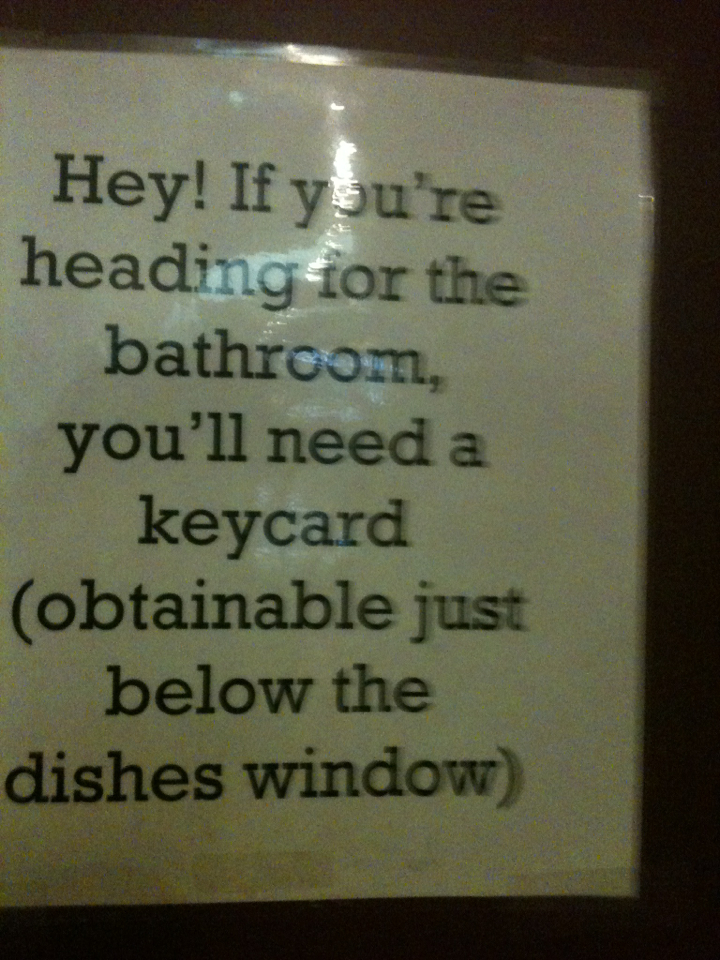
Back stepping. Where is the dishes window? WHAT is a dishes window. Holding legs closer together. Calculating if I feasibly have enough time left.

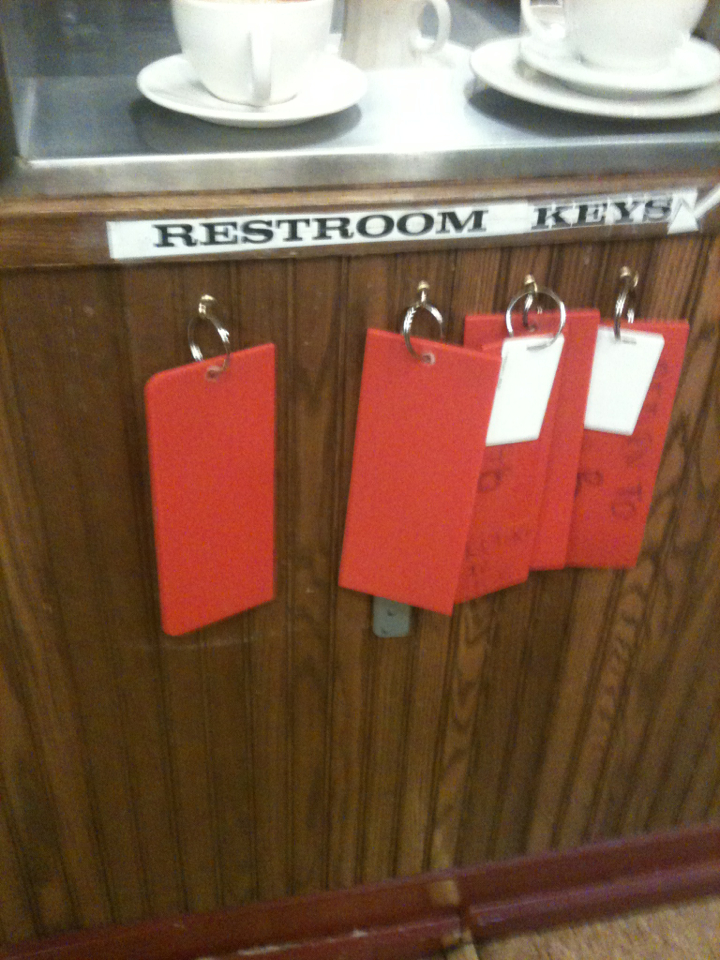
image_1354820775335581

Which one do I take. “Excuse me Ms. Is this the right key?” Holding any random key up. Wondering how many bathroom doors there will be.

image_1354820727753032

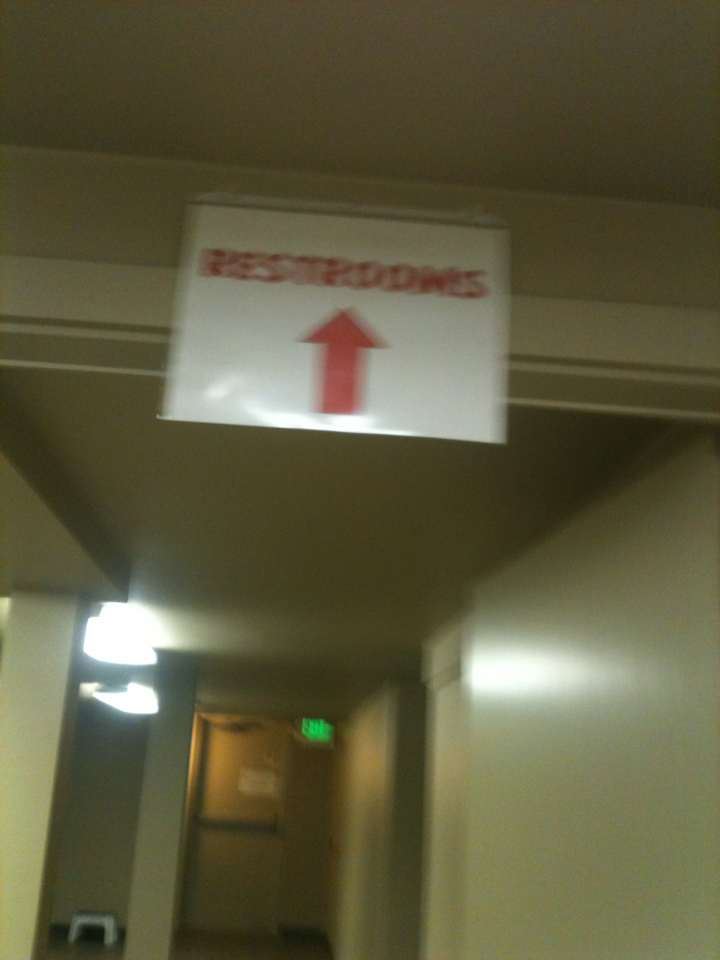
Go through door to find long hallways and more doors and more signs!!!

image_1354820680870428

Indeed. More directions. Lovely.

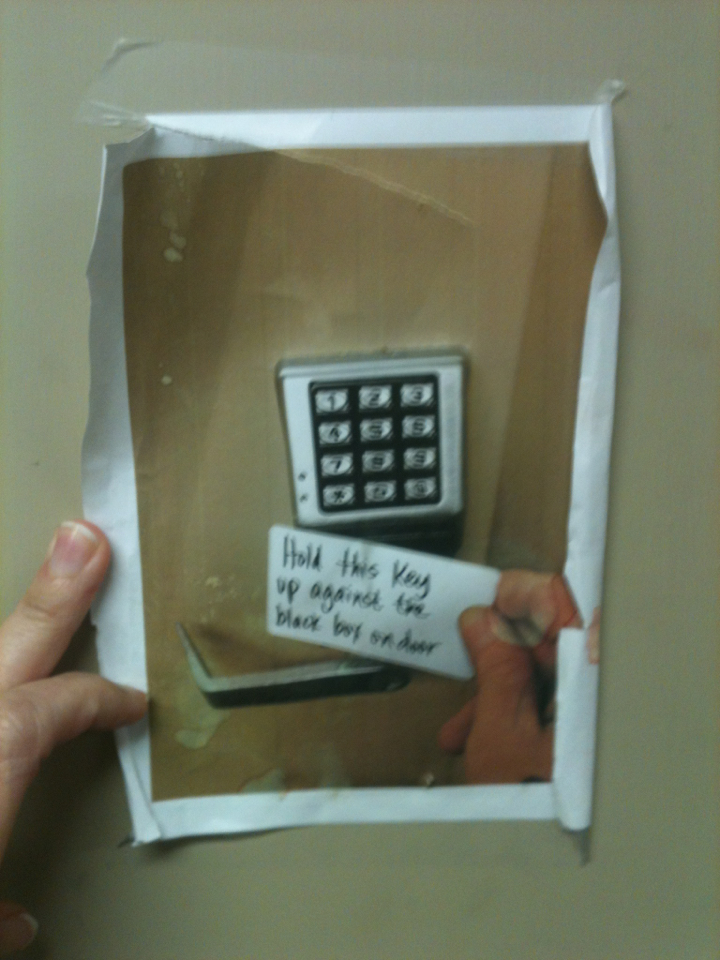
image_1354820706256937

Staring this image down. What if someone is already inside? I hear water running. Do I wait?

How do I scan this fricken plastic card?

A lovely young man arrives, and smiles. “Do you need help? Are you having trouble figuring out what to do?”

“Ummmm,” I say meekly with goofy teenage-grin. “What if someone is inside? Do I enter?”

He is smiling, I think, but I can’t tell, because I am staring at my boots. He offers: “You can just….”

And POOF, the door magically opens as the other female patron exits, and I slip inside, red-faced and flustered and scolding my cute little kidneys.

Mission accomplished.

Quick photo snap of a relieved woman, looking, (not surprisingly), drunk and haggard.

As I’m summing up the last details of my excursion in typed print, the friendly looking gentlemen to my left (lots of men in this coffee shop) he pauses, and glances my way, and asks, “Would you mind keeping an eye on my laptop for a minute?”

Overly zealously, I accept.

I must look trustworthy, I think. Or remind him of his mother.

The irony of the handsome lad’s question settles.

I spend the next five nervous minutes wondering what I would actually do if someone snatched up his laptop. Would I chase them? Would I scream?

I panic.

So much for designating Thursdays as my public outing days…..

267: Cats and Dogs and Penis Envy

I awoke before four in the morning today with words and images twirling nonstop in my mind. I felt like a giant lollipop being dipped in the swirls of sweet wisdom.  Although I was sleepy, and wanting to fall back into a deep slumber, I was made awake, wrapped spiritually in what could essentially be called a lesson review of sorts.

The images and thoughts came swiftly, and with a touch of deliberate humor, ended with memories of my first college course, where I sat a plum-faced, shy freshman girl, surrounded by upper classmen. I had signed up for Psychology of Human Sexuality Course on a whim, having had no clue that the course would actually be about real sex!

I giggled this early morn, as the lesson dancing in my head wrapped up, and I was reminded of the term penis envy, a popular belief back in the early days of my schooling: the thought that many of women’s psychological insecurities are caused by their subconscious desire to have the same package as men.

I chuckled inside at the memory of class, of going around in a circle, and each of us female members of the group describing our degree of envy. Back then, I was so malleable, still am, that any belief system set upon me, I innocently absorbed as truth. Thusly, I went around for many years thinking I wanted to grow male stuff.

Today, in the wee hours of the morn, as the lesson began, with my mind’s eye, I saw numerous dogs and cats posed in various ways in their silly hats and wearing their silly expressions. And then I saw a massive amount of other animals, starting with the more common American pets of snakes, turtles, and hamsters, and ending with pigs and rats, and even monkeys. The debate came to my mind between cat lovers and dog lovers, and then I saw how silly the debate was. I saw that as a society we created these pets as our favorites, and then divided the camps. I thought about why they were our favorites: cuddly, responsive, expressive, fairly clean and predictable, sensitive, and perhaps even thoughtful.

And then I thought that the love of dogs and cats was all by choice, that as a collective we could easily have chosen a pig and a rat as our favorite pets, that instead of cats and dogs that pigs and rats could be there in their place…perhaps in another time or universe.

I began to visualize the various poses of pigs in their holiday wear and with their big eyes, and with captions written across their photos. I could see the rats too, all decked out for the season, with jingle bell vests, and more. It wasn’t such a leap out of our current reality.

In truth, much of what happens is all about what we as a whole choose to make our reality.

Then I realized that the expectations we have upon animals do actually affect the behavior of the overall species. With millions of people thinking dogs are awesomely friendly, no wonder they walk around with goofy grins and wagging tails. I imagine that if the collective believed all natural brunettes were brilliant, fascinating, and someone to aspire to be, I would walk around with my bum shaking a bit too, with goofy smile to boot.

I began to wonder what would happen if we replaced all the cats and dogs (temporarily and in theory only) with two other animals. I visualized the majority of pet owners with a snake at their side, cuddling during a television show, with the turtle tucked under the covers with their owner at bedtime.  And the thoughts didn’t seem so farfetched; for with enough conditioning and collective belief, we have the potential to mold any species’ behavior.

I had intense laughable visuals of a pet owner holding their ant farm during a movie or even housing a bee’s nest in their home and keeping a window open for free access to the fields. I began to see how anything was possible, if enough people believed or accepted a norm. This is evident from culture to culture, when considering what animals are revered, accepted as pets, or eaten for supper.

These thoughts led to the concept of ownership, and the fact that most domesticated dogs are entirely dependent upon their owner. I imagined what that dependency must feel like for dogs, how they must wonder when the food will come, the fresh water, the walks, the grooming, the holding, the words “good dog.” How they live their lives essentially as a prisoner to their master’s behavior, wherein the pet is entirely dependent on what their owner does.

I began to think that perhaps this dependency could cause some dogs a type of sadness, as I believe was in the case of my Goldendoodle, Scooby. For the first couple years of Scooby’s life, Scoob appeared mostly sad and withdrawn, until we brought home another dog. Then his spirit lit up and he seemed to come alive. But then he fell into another sadness spell, shortly after we moved to Washington, and he had less of a yard for roaming. He began to crave walks, and beg for walks, and on the days there were no walks, he sat in the corner forlorn. Scoob also despised all dog food. Most of his days he set about to steal whatever people food he could from out of the sink or atop the stove—like some grizzly bear at a picnic. He was adorable, but primarily a sad pup. Being empathetic to animals, I always sought to cheer him up, through fur massages and rough housing with a stuffed toy, even dancing to music. Still, he seemed to feel as if he was trapped in a life I ordained for him, that I ran, that I created.

This thought led me to the idea of the human experience, that we, too, as a people, have our own masters: our accepted beliefs; and that in truth, the only thing we can control, as many ancient teachings state, are our thoughts.

I suppose my Scooby didn’t have that capacity—to control his thoughts. Instead all he could see at certain times was missed opportunity. Even on the days we walked, he longed for more. Perhaps he would have been the happiest on a ranch estate. Perhaps if he’d had the capacity to daydream, that is where he went, to the golden fields where he could run until his legs gave out beneath him. I like to think that is where he is now, with a perpetual wet-nosed smile upon his face.

From here my thoughts turned to the social taboos of societies. It was at the age of eighteen, in that human sexuality college course, I first learned about how a society actually creates what is socially acceptable. I remember pondering about the collective creating ideals of rights and wrong, popular and unpopular, and loved and unloved.

The way my professor explained social taboo, forever stayed in my mind. The professor asked the class to visualize a planet in which it was socially unacceptable to eat in front of another person; to imagine a place where you were only allowed to eat in private or with a special significant other, a world in which people ate in the dark of their bedrooms, even under the covers; a place where chewing in public was seen as vulgar and disgusting, and punishable by law. My professor explained about how the body opening of the mouth was only to be used for practical purposes in public: for breathing, drinking, and talking. Laughing was a risk, for the mouth might open too wide.

This other world’s eating taboo he then compared to sexual intercourse and the naked flesh taboos of this world.

I remember then that a light bulb turned on in my mind. It was in that classroom I understood that much of what I was told and much of what was modeled were based on a collective’s culture and belief system, and that I was living in a world with unpredictable and shifting values.

In theory what was a norm that day and what was deemed taboo at the same moment would shift with the passing of time. I remember feeling extreme discomfort. I recall analyzing the current taboos of the time, particularly mixed-race marriage and homosexuality. I concluded that in time people’s views would shift, and as a whole our outlook and perception would change, that the unacceptable would become accepted, or at least move in the direction of the majority accepting.

The reality of the collective establishing truth boggled my mind. I could see clearly how I was a part of the collective and even though I was aware that I lived in a society that created truths and rights and wrongs, that even with my awareness I was continually molded by these created truths. I was in essence powerless.

I wondered where the truth really rested, how I could reach it, and how would I know.

I recognized that at a certain level, beyond conscious awareness, I was affected by what others accepted as truth. I recognized ultimately I was affected by what others thought. Living on this planet, the collective belief system was to a degree always to be a cornerstone of my own belief system—their reality, my reality; their conclusions, my conclusions.

I innately knew, I wouldn’t be able to fully grasp multi-dimensions, the supernatural, and the magic of the world, until the majority accepted this as a possibility, but that even then, whatever was believed and grasped onto by the whole could and would once again shift.

I was a dependent part of an intricate and mind-blowing mechanism, no less and no more, and entirely unable to escape. In a sense, I was my dog, my Scooby, waiting in my chair to see what the masters did.

It wasn’t until this morning, through all of these aforementioned thoughts that manifested in a span of twenty-minutes, that I recognized what was happening to me with more clarity: a shift was occurring.

More and more people were expanding their awareness and understanding of the illusion of the world and the power of thought, and thusly so was I.

november-walk

266: Husky Men, Butterflies, and Sunshine

Some early mornings I sit in my van in the driveway and weep deeply. Today was one of those mornings. I listened to a song over and over and let the tears fall.

I’m learning to let my emotions come. And I’m learning to take care of myself. Really take care of me. Because I am precious and lovely.

I took a Dead Sea Salt bath this morning. And I let myself be. This rebalanced me.

I experience extreme emotions, daily. Sometimes they are mine; sometimes I find out that I am experiencing something akin to what a close friend or relative is experiencing.

I’m beginning to understand, to distinguish, the difference between my own emotions and others’. I’m beginning to understand how deeply affected I am by others’ core energy and thoughts—what is their essence, their fears, their joys, their belief and experience….and then beyond that to what is their spirit, the beautiful divine.

My “feelings” take me on great adventures. Often, daily, I spend hours upon hours, as if floating on air. I feel connected to the world, and a profound inner peace. I know without doubt I am surrounded by a fleet of angels, protected, watched and bathed in unyielding love.

There has been a great shift in me the last few weeks; where in I used to be carried away with my extreme emotions, now I am a bystander. I have the ability and capacity to step outside of the experience and become the silent observer offering my inner transitioning self my unconditional support. This other me, this “higher” me, she is constantly content, at peace, and in love with herself, others and life. She isn’t weeping or flying on the air. She just is.

I’ve been “practicing” visualizing what I want in my life. It’s been fun, in that giddy-little-girl way. I keep hearing behind me somewhere, or perhaps from deep within me, to be careful what you wish for, as the universe usually unfolds to give me what my deepest desires are.

I’ve had to reel in some of my own thoughts and needs, and continually pray for the higher good of my self and others, as I have a few fanciful ideas of my own that are only for my pure pleasure.

The other day, actually last week, I wanted to see how this visualizing worked. I wanted something fun and easy. I wanted something light-hearted—something my girlfriends would giggle at.

And so I asked, jokingly, for my angels to make husky (handsome) men in flannel shirts appear all day long. For then I could imagine laughing with my friends at the sudden rugged appearance of flannel-wearing hunks. I carried my friends with me throughout the day. And wouldn’t you know it, at every turn, in the stores shopping, on the streets wheeling out garbage, in cars and trucks and busses, were men in flannels. I wondered what would have happened if I had added the word naked to my list.

The next day I asked for a butterfly, that’s all I wanted. I wanted confirmation from my angels that they hear my prayers. And so, in the dark of winter, I visualized seeing a butterfly in flight. A real butterfly. I was specific. An image wouldn’t do.

I felt inside they would produce this for me. I felt in a few days time I would see a butterfly. And I would know.

Yesterday, we took a trip to a museum. I had no idea or forethought about the exhibits presented there. Turns out there was a huge butterfly exhibit. One where you walk inside, through the humid air and greenery and flowers in bloom, and get to dance within the sweeping butterflies. So many in flight, so many colors, so beautiful. And oh so confirming. I’d like to go back and just sit in the butterfly world for hours upon hours and do nothing but watch them be.

What shall I visualize now?

I visualize your smile, your inner peace, your love, your beauty. And I so wish for you to see how gorgeously lovely you are in every feasible way, in all ways imaginable, the beauty in your richest dearest dreams, and I wish more for you to be lathered in the love of the universe, to be dipped and re-dipped in the goodness that is both you and me. To be overwhelmed with a sense of peace and a knowing you are exactly where you need to be. Bless you and the butterflies. May we all honor our season, whether in cocoon, or nearly set to flight, may we see how divinely brilliant we shine.

May you feel the sunshine on your shoulders, Dearest You!

Even in the smallest events there’s no such thing as coincidence. – Haruki Murakami

Post 242: Still, I Walk On

Dear Angels,

I don’t think I was meant for this earth. My heart is too big and aches too much.

I try to pull myself out of sadness but my efforts are to no avail.

I let go.

I let God.

I try and try.

I sit in emptiness and silence.

I sit in prayer.

I hope and wish and dream.

I try once more.

While I am not tough, I recognize I am brave.

I stand acutely aware of the dangers of life and the inevitability of dying. Change terrifies me, yet my very existence is encompassed by constant change. Still I walk on.

I am bombarded by my mind’s connections, the branching out of complex thoughts in order to make some sense of concepts and happenings. My thoughts, a web, upon a web, upon a web, spinning out exponentially and infinitely with no end, exhaust me. Still I walk on.

The only way to stop the thoughts is to distract. And while the thoughts are endless, the distractions are finite, and have a built-in ability to expire. Expiration leaves me weary and more fearful. The expiration of distraction, too, becomes a fear. Still I walk on.

My empathy depletes my energy sources. With the onset of pain or tragedy, I am left spinning in emotions, uncertain of how to assist, and where to start in the process of uncovering all the information buried beneath layer upon layer of soul-tears. One event turns and quickly bleeds into another—a river of sorts surging and bursting at the bed’s seams and pounding upon terrain after terrain, forging new ground and new thought. Still I walk on.

I see the eyes of the victims of life, hollow, afraid, alone. I understand isolation is a disease of our time, as well as a lingering disconnection. Still I walk on.

Everywhere is poison: food, medicines, waters, earth, animals, man, filled with poison.  Poison as substance and poison as thought. Still I walk on.

I long to sprout wings and hover above, to glide and bless the suffering. I long to weave magic, to soothe and comfort. I long to place a salve of love and salvation across humanity. Still I walk on.

I don’t know where to place my angst, my fear, my pain. And I refuse to pretend life is easy and happy. I question and question: Can I be light and be sad? Can I be light and be confused? Can I be light crying from within the darkness? Still I walk on.

I beg in confusion, and in my absence of vigor and vitality, depleted and drained, I weep. “Give them hope and strength. Show this world, so long emptied of hope a vision, a sign, a destiny. Point us to the path of light.”

And though my feet our weary and my head heavy, still I walk on

With lantern in hand, with angels at my side, I stand motionless, a light to the path, as still, I walk on.